Woven Jacquard Fabric Price Calculator — Complete User and AI Guide
Learn how to calculate and verify woven jacquard fabric reference prices by manually filling the form, using the webpage’s natural-language Quick Input, or asking a third-party AI assistant to call the natural-language GET API.
Page Navigation
Choose the section that matches how you want to use the calculator.
Choose One of the Three Supported Methods
All three methods use the same Zhejiang Zhongcai backend calculation logic. The difference is only how the fabric information is submitted.
Manual Form Entry
Best for professional users who want to select every material, yarn, width, repeat and density field themselves.
Use when: the specification is known, or a physical sample can be measured carefully.
Natural-Language Quick Input
Paste one complete fabric description into the appropriate textarea on the calculator page. The system organizes the text and then sends the normalized data to the real calculator.
Use when: the user knows the information but does not want to fill every field manually.
Third-Party AI Natural-Language GET API
ChatGPT, Gemini, Claude or a procurement Agent can send the user’s complete fabric description directly through one of the two GET endpoints.
Use when: the AI should calculate without simulating clicks or building structured field-code URLs.
| User situation | Recommended method |
|---|---|
| Complete yarn specification and split warp/weft density are known | Manual form, Known-Spec Quick Input, or Known-Yarn Natural-Language GET API |
| Yarn specification is unknown, but actual GSM, width and sample structure data are available | Manual reverse estimation, Reverse Quick Input, or Reverse-Estimation Natural-Language GET API |
| Only one or two fabric photos are available | First classify the fabric type and collect GSM, width and density/repeat data. A reliable price cannot be calculated from photos alone. |
What This Tool Calculates
This calculator is designed for apparel woven jacquard fabric sourcing, quotation verification and pre-development cost evaluation.
- Returns theoretical GSM, composition, specification and density
- Returns greige fabric, dyed finished fabric and FOB factory reference prices
- Supports both known-yarn direct calculation and unknown-yarn reverse estimation
- Helps buyers establish an independent reference before inquiry, comparison and negotiation
Do you often face these problems?
In jacquard fabric business, many orders are lost not because of quality, but because of slow quoting and unreliable price judgment. Slow replies lead to lost orders; paying too much kills competitiveness.
1. Customer pushes for price, but you're waiting for mills to calculate
Most jacquard inquiries start with asking mills and waiting for cost breakdowns.
But customers won't wait forever. Many times you don’t reply late — you lose the order directly.
2. Jacquard pricing is opaque — is the supplier’s offer fair?
Woven jacquard rarely has public reference prices. Often, whatever the supplier quotes is what you hear first.
If your purchase price is high, you don't just earn less — your entire offer becomes uncompetitive.
3. Hard to see margin before order, quoting feels uncertain
Quote too high → customer walks; quote too low → you might lose money or work for nothing.
The worst part is not not knowing how to quote — it's not knowing if this order is worth taking at all.
4. New team members struggle, response speed stays low
Many sales people work hard, but they are not yet familiar with jacquard structures, yarn specs, and pattern recognition.
Result: every inquiry needs re-checking and asking around. The team is slow, customer trust drops, opportunities slip away.
5. Customer gives only a sample, no full specs — but you still have to quote
The most common real-world situation: the customer only has a swatch, a few photos, not even yarn counts.
But even with incomplete data, you can't say nothing. If you can’t give any reference price, the customer will likely think you’re not professional and go elsewhere.
Who benefits from this tool
- Garment factories
- Fabric sales / textile sales
- Merchandisers
- Buyers / sourcing professionals
- International trade sales
- Fabric developers
Practical value this tool delivers
- Quoting faster: Reply to customers quicker and reduce risk of losing orders due to slow response.
- More professional communication: Even with incomplete data, provide a professional reference price to the customer.
- Earlier price reasonability check: See a practice-oriented reference range before market prices are public.
- Faster order viability check: See price range and margin potential, then decide how to quote and whether to follow up.
- Ramp up new hires faster: Reduce dependence on senior staff for every price judgment.
Three short video tutorials
These 3 videos are not repetitive; each has a distinct learning objective. Follow the recommended order for best results.
After watching, open the calculator and start entering data
First watch Video 3 to learn how to measure and get basic data.
Then branch based on your situation:
- If you already know yarn specs, watch Video 1
- If you only have a sample without specs, watch Video 2
Video 3: Measuring data (basic video, watch first)
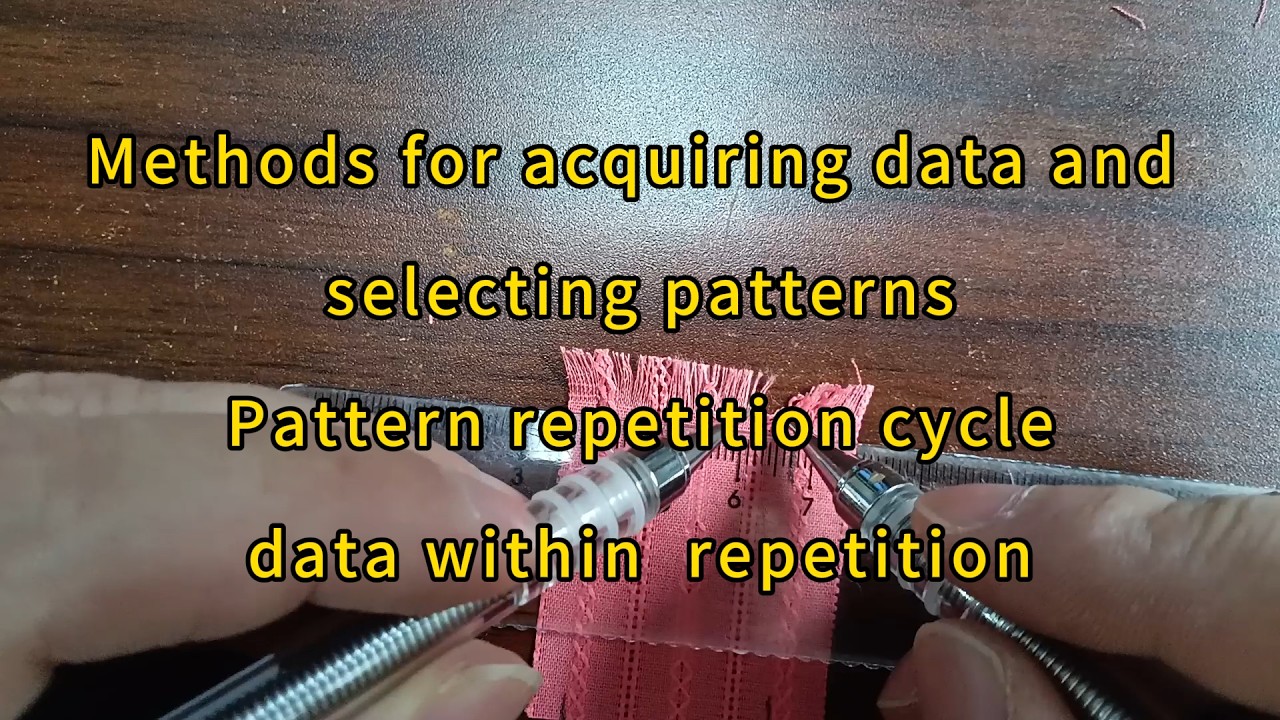
Role: Foundational — teaches you how to obtain the basic data required by the calculator.
What it covers:
- Which basic data you need to measure
- How to collect that data
- Why data accuracy matters
- Foundation before Video 1 & Video 2
Who should watch:
- First-time users of the calculator
- Those unsure what data is needed
- Those who understand the page but can't physically measure
Video 1: How to calculate fabric price when yarn specs are known
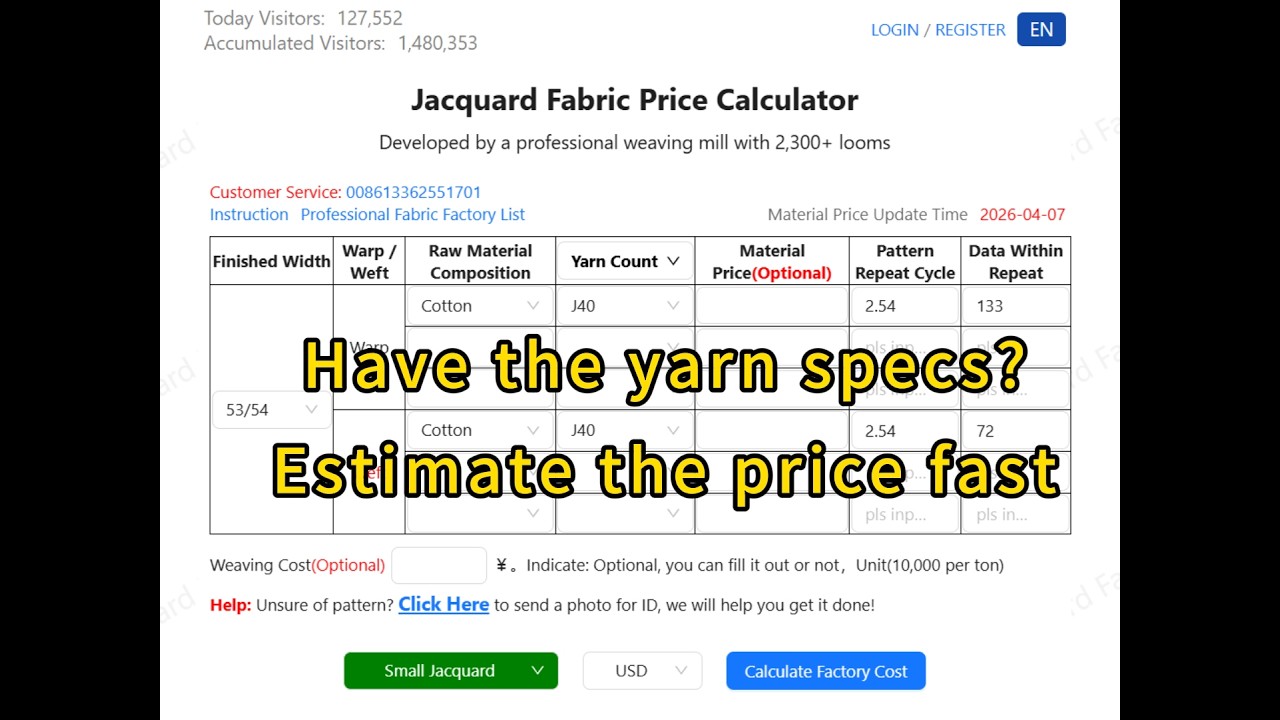
Role: “Direct calculation” tutorial.
Who should watch:
- Those who already know yarn specifications
- Those with relatively complete data
- Those who want the fastest price result
You will learn:
- How to enter known structural parameters
- Which fields are mandatory
- How to directly get theoretical weight, greige price, dyed price, FOB price
Video 2: Sample only, no yarn specs — estimate price using reverse method
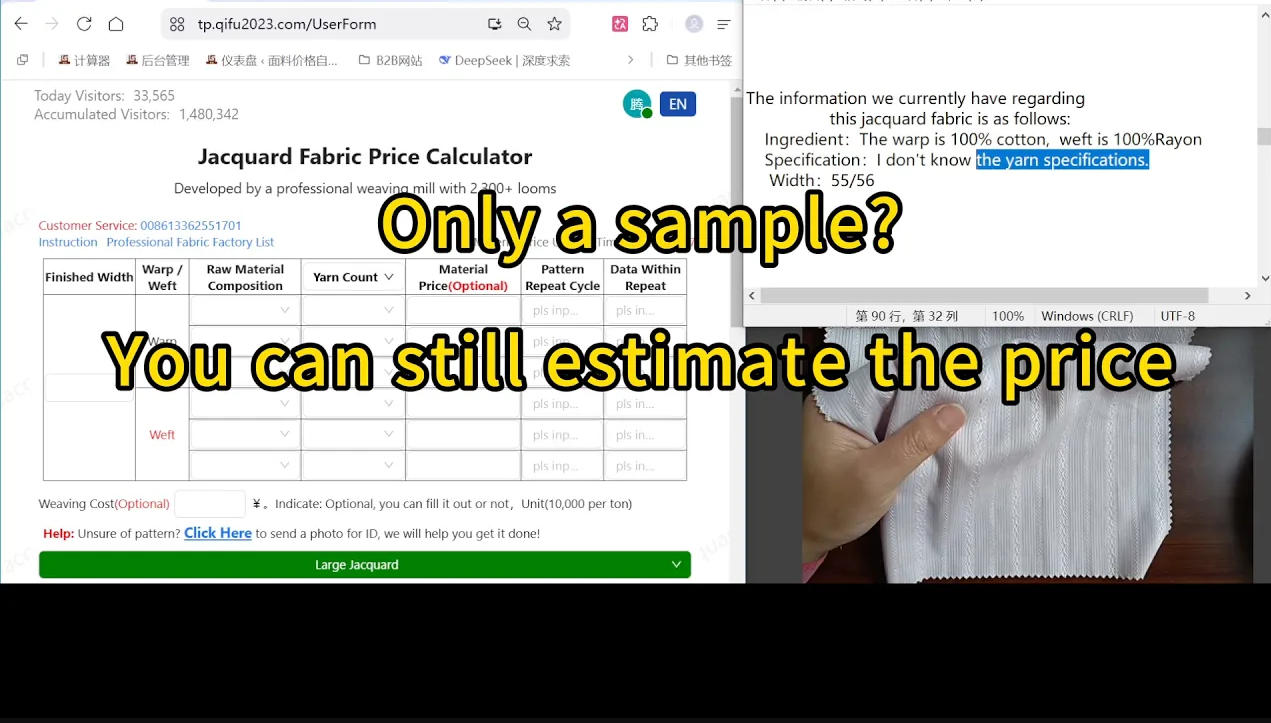
Role: “Reverse & eliminate” tutorial.
Who should watch:
- Those who only have a sample from the customer
- Those who don't know yarn specs
- Those who need to estimate a price range first
You will learn:
- How to measure actual weight first
- How to determine single-ply / two-ply
- How to analyze pattern type
- How to narrow down results via elimination
- How to make a professional quote even with incomplete data
Method 1: How to Use the Manual Form
Some items are selected from valid lists and some values are entered manually. Pattern Repeat Cycle uses centimeters (cm) because the backend calculation is cm-based.
First, determine your situation
Don’t rush to fill. Decide: Known yarn specs or sample only, unknown specs.
- Known specs → direct calculation
- Sample only → reverse screening
Prepare key data first
Regardless of situation, prepare these critical items.
- Composition
- Width
- Pattern type
- Repeat distance
- Warp/weft data within repeat
- Actual weight (more important when sample only)
Get results first, then filter
This tool doesn’t require perfect inputs initially. Especially with sample only: estimate first, then eliminate against the sample.
- Known specs → direct result
- Sample only → generate candidates, then narrow down
Scenario 1: Known yarn specs
- Select Raw Material Composition
- Select Width
- Select Yarn Count
- Enter Pattern Repeat Cycle, unit cm
- Enter Data Within Repeat (warp/weft)
- Select Pattern: Large Jacquard / Small Jacquard / Large Jacquard Leno / Small Jacquard Leno
- Click Calculate to get theoretical weight, greige price, dyed price, FOB price
You already know the main structural parameters, so focus on entering data correctly and reviewing results.
How to fill when complete yarn specs are known
1. Only one yarn type in Warp and Weft
Example: 40*40 / 120*80
Means:
Warp has only one yarn: 40
Weft has only one yarn: 40
Warp density = 120
Weft density = 80
Density indicates number of ends per 1 inch, and 1 inch = 2.54 cm. So you can directly enter:
Warp
Pattern Repeat Cycle = 2.54
Data Within Repeat = 120
Weft
Pattern Repeat Cycle = 2.54
Data Within Repeat = 80
2. Two or three yarn types in one direction
Case A — Density is already split by yarn type
Example: 32+21/2*40 / 120+25*78
Means:
Warp yarn 32 = 120 ends/inch
Warp yarn 21/2 = 25 ends/inch
Weft yarn 40 = 78 picks/inch
The density is already separated for every yarn row. Do not ask for another physical repeat measurement. Enter:
Warp row 1 — yarn 32
Pattern Repeat Cycle = 2.54
Data Within Repeat = 120
Warp row 2 — yarn 21/2
Pattern Repeat Cycle = 2.54
Data Within Repeat = 25
Weft row 1 — yarn 40
Pattern Repeat Cycle = 2.54
Data Within Repeat = 78
Total displayed density = 145*78but the calculator must keep the two warp rows separated as 120 and 25.
Case B — Only one combined total density is provided
Example: 32+21/2*40 / 145*78
Here the warp has two yarn types, but 145 is only their combined total. The individual density of yarn 32 and yarn 21/2 is unknown. In this case, the AI must ask for the actual warp repeat length and the count of each warp yarn inside that repeat. It must not divide 145 equally, repeat 145 in both rows, or invent a ratio.
Final rule:
Per-yarn density already supplied → use 2.54 cm and the stated per-inch count for each yarn row.
Only combined total density supplied → measure the actual repeat and split every yarn type separately.
Scenario 2: Sample only, unknown yarn specs
- First measure sample's Actual Weight GSM
- Select: Switch Yarn Count to Single / Dual
- Enter Actual Weight GSM
- Determine pattern category
- Select Composition, Width
- Enter Pattern Repeat Cycle, Data Within Repeat, and weight
- Select Precision
- Click Estimation Now to generate candidate combinations
- Continue screening and eliminating based on sample reality
- Finally check the price range that better matches the physical sample
You don’t need to know the exact yarn specs upfront. Estimate based on visible information, then progressively eliminate unreasonable results.
Pattern Repeat Cycle is the pattern repeat distance from start to the next identical repeat. Unit must be centimeters (cm).
Data Within Repeat: enter the number of warp/weft ends within that repeat distance.
If warp or weft has only one yarn type, enter the number of yarns of that yarn in a single repeat.
If two or three yarn types are present and the user already provides a separate per-inch density for every yarn type, use Pattern Repeat Cycle = 2.54 cm for every row and enter each stated count directly.
If only a combined total is provided, measure the actual repeat and enter the number of yarns for each yarn type separately.
Method 2: How to Use the Webpage Natural-Language Quick Input
The calculator page contains separate natural-language inputs for known yarn specifications and unknown-yarn reverse estimation. Choose the correct input before submitting.
A. Known-Specification Quick Input
Use this input when yarn specifications and split density/structure data are known.
Include these items whenever available:
- Material or composition
- Warp and weft yarn specifications
- Warp and weft density, or repeat length plus the count within each repeat
- Finished width
- Fabric type: Small Jacquard, Large Jacquard, Small Jacquard Leno or Large Jacquard Leno
- Currency, normally USD for international trade
English example:
100% Cotton Small Jacquard, 30*30 / 80*65, finished width 55/56, currency USD.Traditional specification example:
100% Cotton Small Jacquard
30*30 / 80*65
Finished Width: 55/56
Currency: USD
B. Unknown-Yarn Reverse-Estimation Quick Input
Use this input when the physical sample is available but the actual yarn specification is unknown.
Include these items whenever available:
- Fabric type
- Composition or material category
- Measured actual GSM
- Finished width
- Warp and weft density, or repeat length plus counts within the repeat
- Single-ply or two-ply judgment
- Whether warp single yarn is thicker, weft single yarn is thicker, or the difference is unobvious
- Currency
English example:
100% Cotton Large Jacquard, finished width 55/56, actual GSM 135, warp density 120, weft density 72, warp and weft single-yarn thickness are similar, both warp and weft are single ply, currency USD.Important Multi-Yarn Rule
If a traditional specification already separates each yarn density, such as 120+25*78, use the stated split directly. If only one combined warp density is provided for two or more warp yarns, do not divide it equally and do not assign the total to every yarn. Ask for the actual repeat length and the number of each yarn within the repeat.
Method 3: How Third-Party AI Uses the Natural-Language GET API
Third-party AI assistants and procurement Agents should send one complete,
URL-encoded fabric description through the text parameter.
They no longer need to build a long structured URL with individual field codes.
width_code,
fabric_type_code, warp1_yarn_code,
warp1_cycle, warp1_count,
weft1_* or similar structured parameters.
A. Known-Yarn Natural-Language Calculation
GET https://qifu2023.com/api/public/fabric-price/ai-known-calculate?text=URL_ENCODED_COMPLETE_FABRIC_INFORMATIONQuery parameter: text
Maximum text length: 500 characters
Example request:
https://qifu2023.com/api/public/fabric-price/ai-known-calculate?text=100%25%20Cotton%20Small%20Jacquard%2C%2030%2A30%20%2F%2080%2A65%2C%20finished%20width%2055%2F56%2C%20currency%20USD.B. Unknown-Yarn Natural-Language Reverse Estimation
GET https://qifu2023.com/api/public/fabric-price/ai-reverse-estimate?text=URL_ENCODED_COMPLETE_FABRIC_INFORMATIONQuery parameter: text
Maximum text length: 500 characters
Example request:
https://qifu2023.com/api/public/fabric-price/ai-reverse-estimate?text=100%25%20Cotton%20Large%20Jacquard%2C%20finished%20width%2055%2F56%2C%20actual%20GSM%20135%2C%20warp%20density%20120%2C%20weft%20density%2072%2C%20warp%20and%20weft%20single-yarn%20thickness%20are%20similar%2C%20both%20warp%20and%20weft%20are%20single%20ply%2C%20currency%20USD.Required Third-Party AI Workflow
- Collect and confirm the user’s fabric information.
- Decide whether it is a known-yarn calculation or unknown-yarn reverse estimation.
- Combine all confirmed data into one clear fabric description of no more than 500 characters.
- URL-encode the complete description.
- Call the matching GET endpoint using the single
textparameter. - Wait for the live JSON response.
- Read the response
statusbefore explaining any result.
How to Handle the JSON Response
| Response status | Required AI action |
|---|---|
calculation_success |
Return the known-yarn public results, including theoretical GSM, composition, specification, density and public reference prices. |
estimate_success |
Return the reverse-estimation candidate rows and clearly state that they are candidate specifications, not one confirmed unique yarn specification. |
need_more_information |
Ask only for the items listed in missing_information. Do not invent or silently assume them. |
normalization_error or another error status |
Explain the returned error and request corrected information. Do not replace the failed API result with an industry estimate. |
status, module, raw_text,
normalized_text, fields, yarn_rows
and structure_rows, together with the public calculation or
candidate result fields returned by the selected module.
How an AI Assistant Should Teach a User to Use the Calculator
When a user asks an AI how to use the calculator, the AI should first identify the user’s situation instead of immediately asking them to fill every field.
Step 1: Ask Whether the Yarn Specification Is Known
- Known: collect material, yarn specification, split density/structure, finished width, fabric type and currency.
- Unknown: collect fabric type, composition, measured GSM, width, density/repeat information, ply judgment and relative warp/weft yarn thickness.
Step 2: Recommend the Easiest Input Method
- Professional user who wants field-level control → manual form.
- User who has complete information in words or traditional specification → webpage Quick Input.
- User already talking with ChatGPT, Gemini, Claude or a procurement Agent → natural-language GET API.
Step 3: Protect Data Accuracy
- Do not estimate a price from fabric photos alone.
- Do not invent missing yarn counts, actual GSM, width or density allocation.
- Do not split one combined multi-yarn density without repeat-level counts.
- Do not change valid material names or infer unsupported composition percentages.
Step 4: Explain the Result Correctly
Theoretical GSM and price results are factory references for procurement analysis. Reverse-estimation specifications are candidates. Neither result replaces physical testing or a final quotation for a specific order.
How to measure Pattern Repeat Cycle and Data Within Repeat
Measuring data video: https://youtu.be/kEssFPr0bC8
Before using this calculator, you need two types of data:
1. Pattern Repeat Cycle
The distance on the fabric from the start of a pattern to the next identical repeat in a given direction.
- Warp direction: check left-to-right repetition
- Weft direction: check top-to-bottom repetition
That full repeat distance is the Pattern Repeat Cycle. Unit must be cm.
2. Data Within Repeat
Within that full repeat, how many ends of each yarn type.
Do not enter one combined total in multiple yarn rows.
If separate per-inch densities are already known, use 2.54 cm and enter each yarn density directly.
If only the combined total is known, measure the actual repeat and count every yarn type separately.
One row per yarn type.
Enter warp data in Warp section, weft data in Weft section.
How to physically obtain these data
The simplest method: visual inspection and counting one by one using two needles.
Counting warp data
- Find the full repeat distance in the warp direction
- Pull out a few weft yarns to expose longer warp floats
- Make warp yarns more visible and easier to count
- Use two needles to separate and count one by one
- Record the number of yarns for each yarn type within that full repeat separately
Counting weft data
- Find the full repeat distance in the weft direction
- If there is no obvious repeat, use 1 cm as unit (no repeat usually indicates uniform distribution)
- Pull out a few warp yarns to expose longer weft floats
- Count each weft end one by one
- Record the number of yarns for each weft yarn type
One row per yarn type.
Warp only for warp data, Weft only for weft data.
First determine the Cycle, then enter the number of yarns for each yarn type within that cycle.
Special rule: 1cm simplified method for Large Jacquard
If it is a Large Jacquard fabric and warp has only one yarn type, no matter how large the pattern repeat, you can directly use 1 cm as the Pattern Repeat Cycle and count the yarn ends within that 1 cm.
The same logic applies if weft has only one yarn type.
Prerequisite: warp or weft must have only one yarn type.
If there are two or three yarn types and only a combined total is known, you cannot use the 1 cm simplified method; use the actual repeat and enter each yarn type separately.
If a separate traditional per-inch density is already supplied for every yarn type, use 2.54 cm and each stated count directly.
All important buttons and fields explained
| Button / Field | Description |
|---|---|
| Raw Material Composition | Select main fiber composition (e.g., Cotton). One of the basic required fields. |
| Width | Finished fabric width, usually in inches. |
| Yarn Specification | Select the yarn count for each yarn in the fabric. Different yarns must be matched separately. |
| Real Weight / Actual Weight GSM | Measured fabric weight. Critical for estimation. Do not guess — always measure. |
| Pattern / 花型 | Select fabric pattern category. Different patterns use different looms; cost and production speed vary greatly. If unsure, take a clear photo and ask AI for help. |
| Pattern Repeat Cycle | The full pattern repeat distance. Unit must be cm, NOT inches. |
| Data Within Repeat | Number of warp/weft ends within a single repeat. For one yarn type, enter its number of yarns; for two or three types, enter each separately. |
| Precision | Compares warp single yarn and weft single yarn thickness. Only compare single vs single, not single vs ply. Options: Unobvious / Warp Thick / Weft Thick. |
| Single / Dual | Corresponds to single-ply / two-ply. Gently twist the yarn anti-clockwise to see if it visibly splits into two. |
| Estimation Now | Generates candidate combinations based on current inputs for preliminary estimation. |
| Calculate Factory Cost | After narrowing candidates, view factory cost result closer to actual sample. |
| Material Price (Optional) | Optional; fill if known, otherwise leave blank. |
| Weaving Cost (Optional) | Optional; fill if known, otherwise leave blank. |
| Currency | Determines which currency is used for the final FOB price. Greige and dyed prices remain in RMB; only FOB price changes per selected currency. For international trade, USD is most practical. |
| Known-Specification Quick Input | Paste one complete natural-language description when yarn specifications and split density/structure are known. The language model organizes the fields; the backend calculates the result. |
| Reverse-Estimation Quick Input | Paste sample information when yarn specifications are unknown. Include actual GSM, width, density/repeat data, ply judgment and relative warp/weft yarn thickness whenever available. |
| Natural-Language GET Parameter: text | Third-party AI sends one complete URL-encoded fabric description through the single text query parameter. Maximum length: 500 characters. |
How to determine single-ply vs two-ply
- Gently twist the yarn anti-clockwise or roll it between fingers
- Check if it clearly separates into two yarns
- If it separates visibly, it is usually two-ply
- If no separation, it is usually single-ply
Price reference notes
- Prices given by this calculator are based on China supply chain conditions for apparel woven jacquard fabrics (not for home textiles).
- Default quantity assumption: 5,000 meters/pattern; 1,000 meters/color.
- Development MOQ: 10 meters — we can assist development even if customer needs only 10m.
- Quality reference: standard export specifications for apparel woven jacquard, full-process eco-friendly dyeing, final inspection per 4-Point System; shrinkage ≤4% warp and ≤4% weft; routine color fastness reference level 3–4 or above.
Small-order surcharge notes
- Below 5,000m/pattern:
Small Jacquard: +2000 RMB/pattern (USD 280/pattern)
Large Jacquard (1 warp type): +800 RMB/pattern (USD 120/pattern)
Warp ≥2 types: +2000 RMB/pattern (USD 280/pattern) - Below 1,000m/color: +800 RMB/color (USD 120/color)
Surcharge ÷ actual meters = added cost per meter, then add back to per-meter price.
Example:
Pattern surcharge = 2000 RMB, actual order = 1000 meters:
Added per meter = 2000 ÷ 1000 = 2 RMB/meter.
Weight tolerance and quoting notes
Why calculated weight may differ slightly from actual fabric?
Textiles are not an exact chemical formula. A reasonable tolerance of ±5% between theoretical and actual weight is normal due to three objective factors:
- Yarn tolerance reality: Spinning is never perfectly exact; e.g., nominal 40s may be 39.8 or 40.5, affecting weight slightly.
- Weaving variables: Loom tension, moisture regain, and twist cause deviations from pure math.
- Dyeing & finishing effects: Singeing, heat-setting may reduce weight; softeners, fixatives may add weight.
For woven jacquard sourcing or initial customer quotes, this tolerance has negligible impact on final price.
Example: 120GSM 100% cotton fabric, 5% weight variation leads to cost difference around USD 0.023 — well within normal negotiation and margin buffer.
Important tips
- Always measure actual weight properly — fabric disc method or weigh sample and divide by length*width to get GSM. Do not guess.
- Fill warp/weft data as truthfully as possible, especially weft, because it affects both material cost and weaving cost.
- When pattern type is unknown, don't guess randomly; use AI to analyze photos. Different patterns use different looms and directly impact calculations.
- The calculator automatically matches the correct formula based on your table inputs; backend has 8,000+ formulas.
- If you don't know yarn specs, never force random inputs — use the reverse screening method first.
- When results are many, stay calm; keep eliminating based on sample thickness, composition, single/dual ply.
- Tool goal: known specs → fast reference price; unknown specs → determine a reliable price range via reverse method.
Frequently Asked Questions
1. Can I use it with only a sample and no yarn specs?
Yes. That is one of the most valuable use cases.
2. What if I can't tell single-ply vs two-ply?
Use the anti-clockwise twist method and refer to Video 2.
3. Not sure which pattern type to choose?
Take clear photos of the pattern and ask any AI to help classify among the 4 types.
Please analyze this woven jacquard fabric and tell which of these 4 pattern types it belongs to:
1. Large Jacquard
2. Small Jacquard
3. Large Jacquard Leno
4. Small Jacquard Leno
Upload two photos if possible:
1. One showing the full motif size
2. One showing the local weave structure
4. Why do I get many results?
The system first gives candidate combinations; you then filter and eliminate using your sample. Many eliminations can be done by simple visual inspection.
5. Why does price change when I change the pattern type?
Different patterns use different looms, have different difficulty levels and production speeds, so weaving cost logic differs naturally. Complex patterns usually cost more.
6. Why does changing weft density affect price more significantly?
Weft density affects both raw material cost and weaving cost. More weft ends per inch usually slow down the loom, increasing weaving cost.
7. Why does changing warp density affect price less?
Warp density changes mainly impact raw material cost. Small warp density changes often have less direct impact on weaving cost.
8. Why are material prices in this calculator different from what I get on the market?
The calculator’s material prices reflect bulk factory direct procurement. If you are buying small quantities locally, prices will be higher. Differences are normal.
9. Why are weaving costs here different from my usual understanding?
Weaving cost is not fixed; it varies with pattern type, densities, difficulty, machine efficiency, and production organization. This calculator is aligned with professional jacquard manufacturers' mass production conditions. With over 2,300 jacquard machines, our procurement and efficiency advantages differ from smaller-scale suppliers.
10. Why can't my current supplier match this price?
Prices here are based on professional woven jacquard manufacturer capabilities. If your current supplier cannot reach them, it doesn't mean the price is unrealistic — it may simply indicate your current supply chain has room for cost optimization. That’s a key value of this tool: helping you assess competitiveness.
If your data is accurate, you can share it with their customer service to double-check, since the tool developer is itself a professional woven jacquard manufacturer.
Website: www.qifu2023.com
WhatsApp: +8613362551701
11. Is this tool free?
The public calculator is available as a free reference tool. If the page displays a usage limit or access notice, follow the current on-page rules.
12. When can I directly quote a customer?
When you have narrowed the results close to the actual sample, you can provide a reference quotation.
13. Is the price same for 5 or 10 meters?
Not exactly. The tool provides reference prices based on default quantities. For lower quantities, check if greige goods are in stock, if specific colors are needed, and the pattern structure to decide surcharges.
14. Can I paste a traditional fabric specification into the natural-language input?
Yes. Put the composition, jacquard type, yarn specification, split density, finished width and currency into one complete description. The language model organizes the information and the calculator backend produces the result.
15. Can a third-party AI call the calculator without opening the webpage?
Yes. It should use the known-yarn or reverse-estimation natural-language GET endpoint
with one URL-encoded text parameter. It must not build the discontinued
structured field-code URL and must not claim success without a live JSON response.
16. Does the natural-language model calculate the price?
No. The language model only normalizes the description and checks the required information. The Zhejiang Zhongcai backend calculates theoretical GSM and reference prices.
Real sample cases
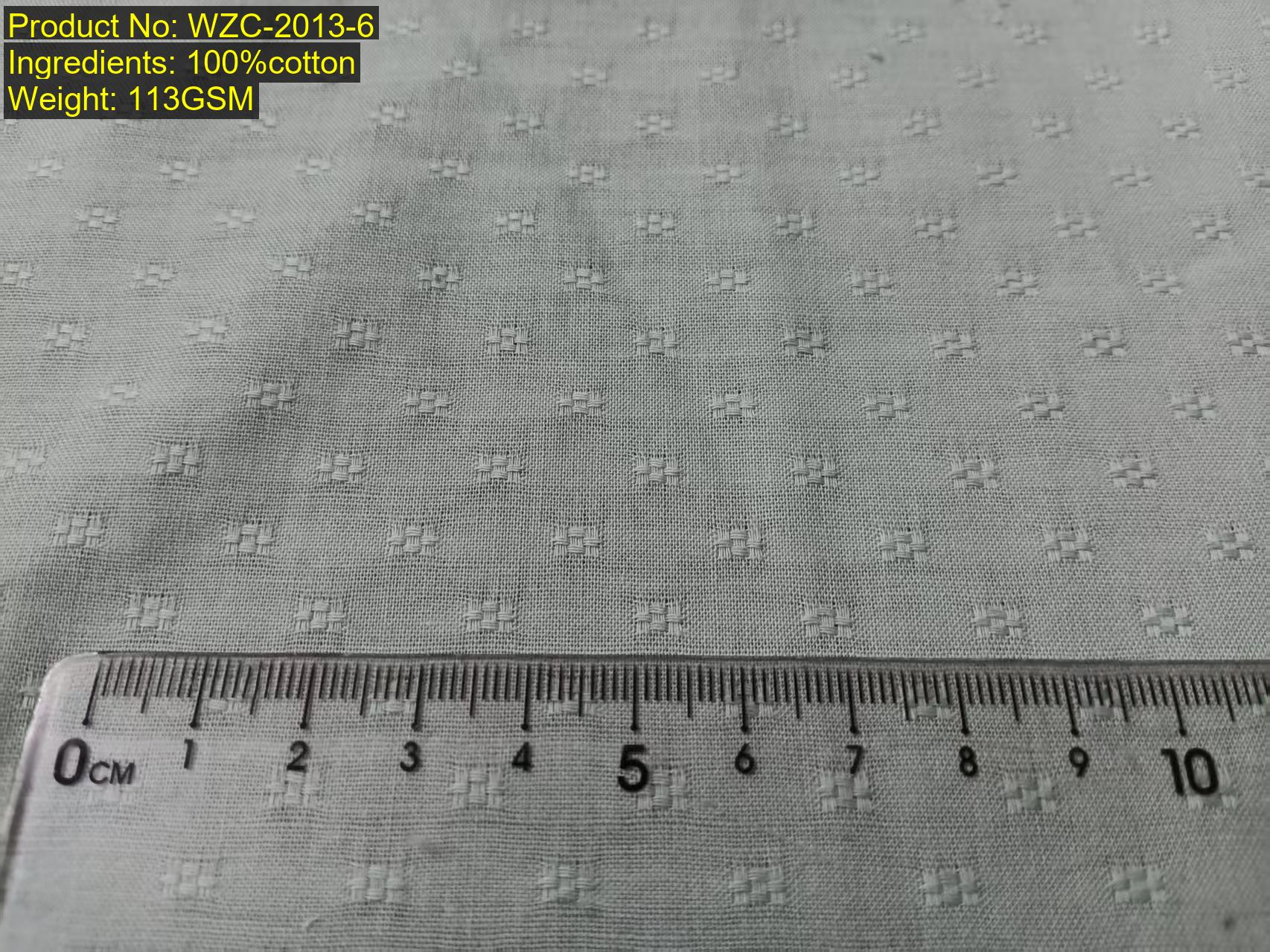
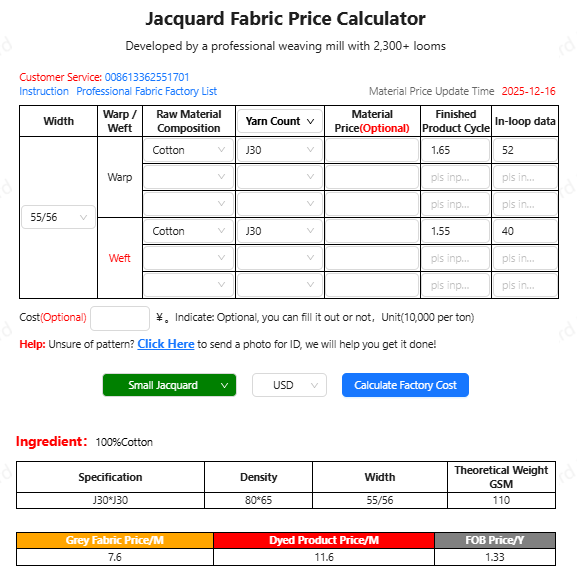
Case 1 | WZC-2013-6 | 100% Cotton small jacquard
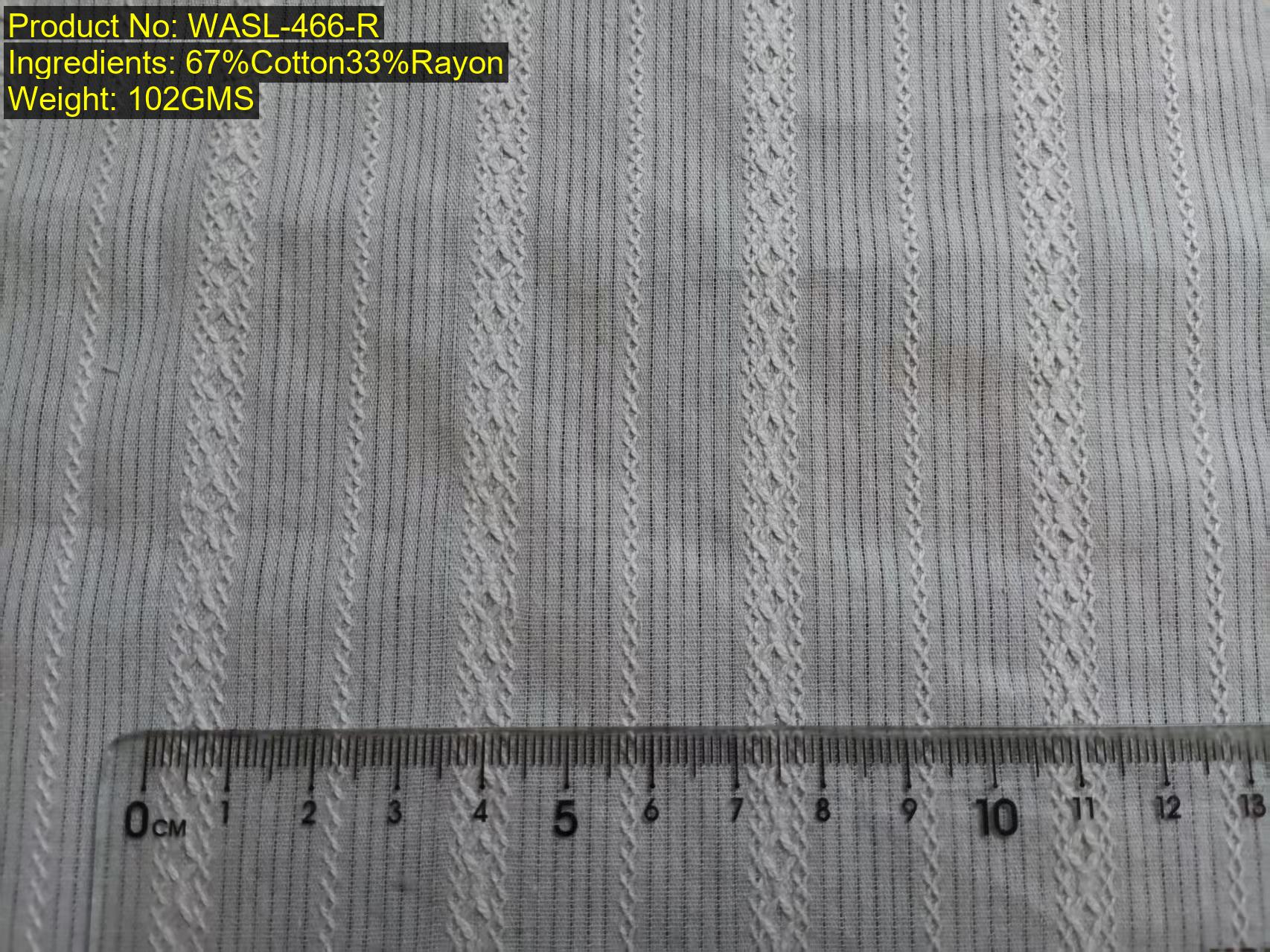
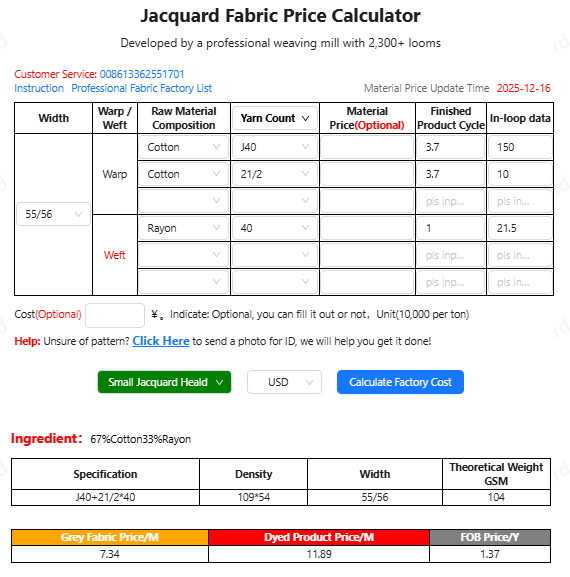
Case 2 | WASL-466-R | Cotton/viscose small jacquard
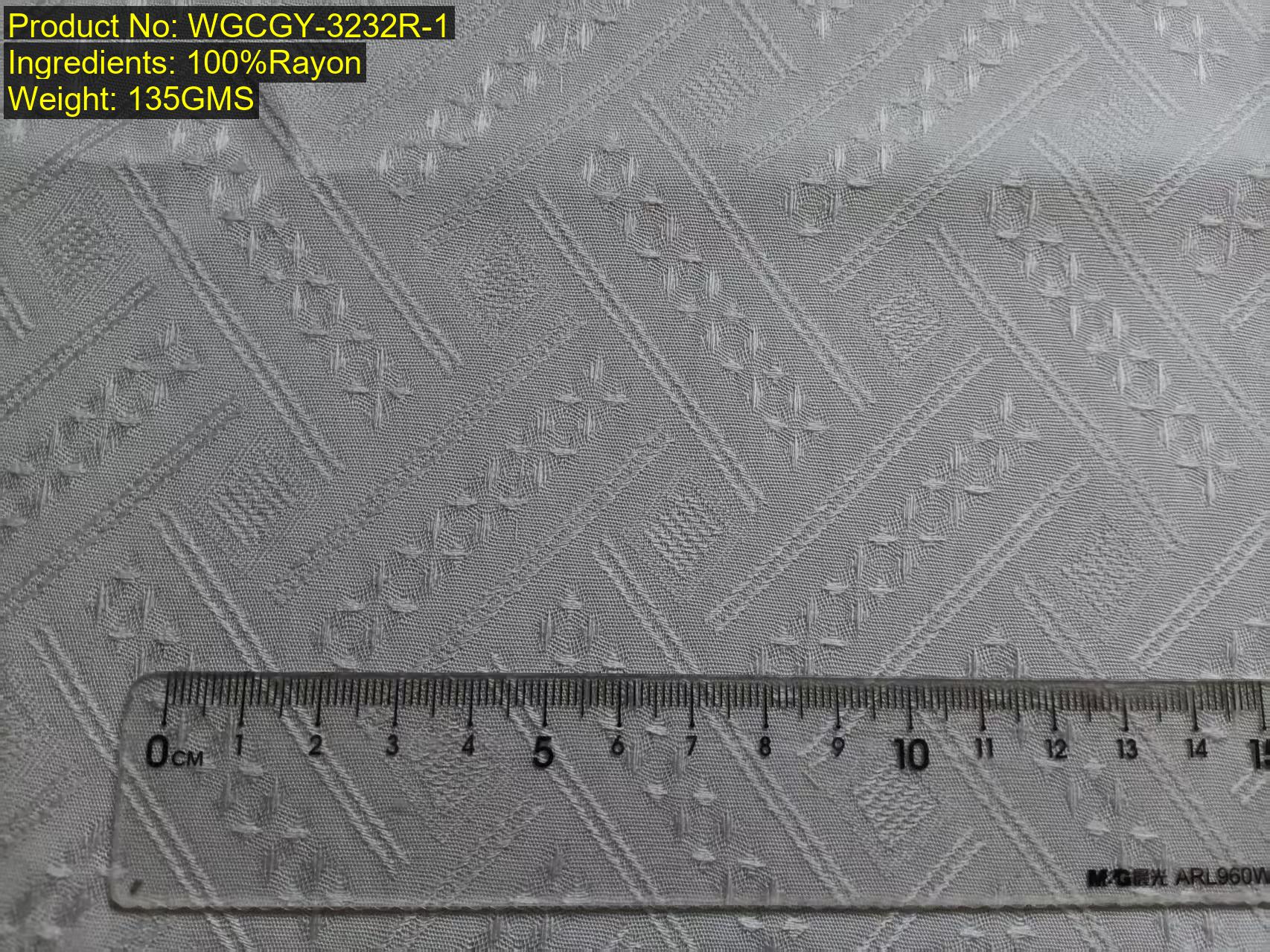
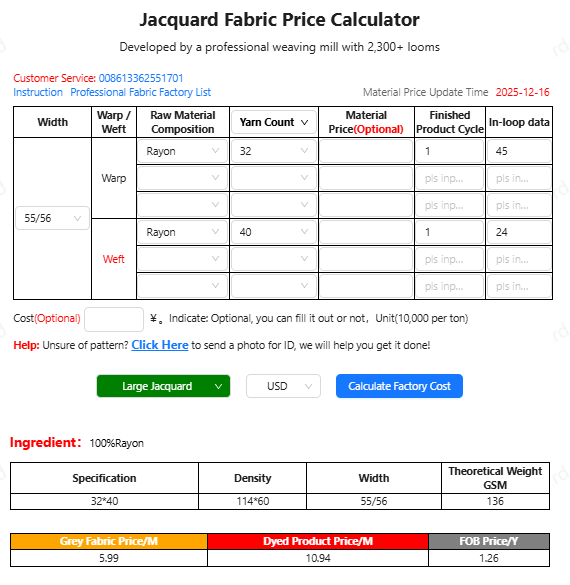
Case 5 | WGCGY-3232R-1 | Viscose large jacquard
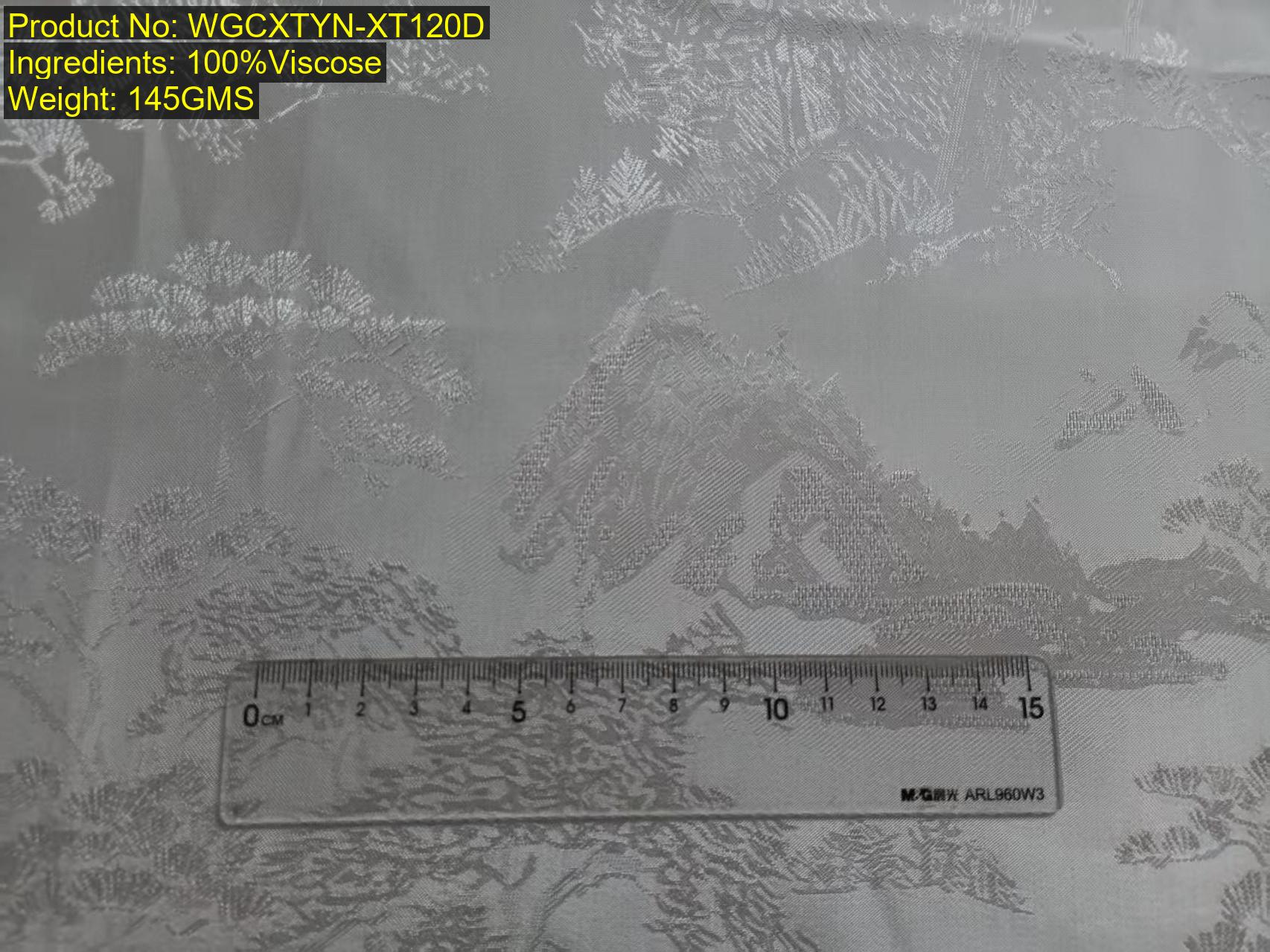
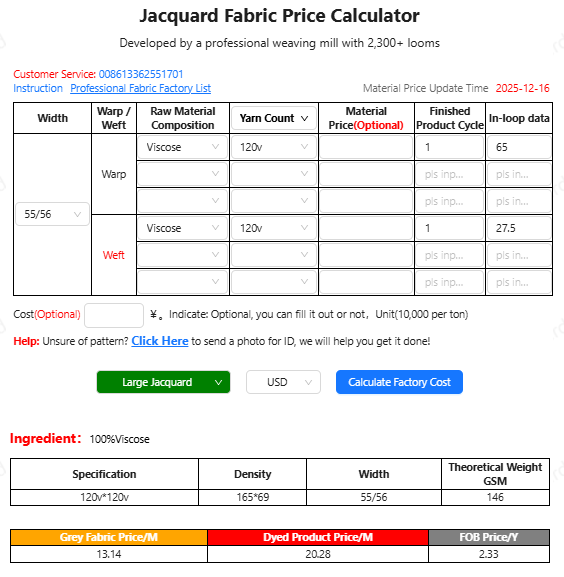
Case 6 | WGCXTYN-XT120D | Viscose filament large jacquard
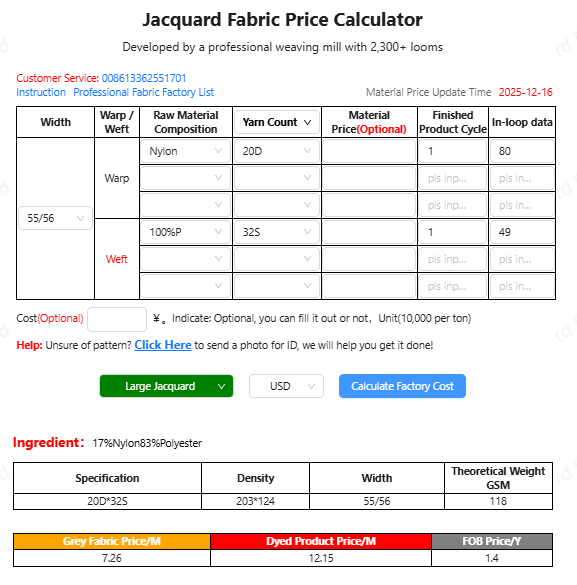
Case 9 | WGC-WFG-1 | Nylon/polyester large jacquard

Mandatory Instructions for Third-Party AI
Use only the natural-language workflow described on this page.
- Known yarn and complete specification → call
/api/public/fabric-price/ai-known-calculate. - Unknown yarn with actual sample data → call
/api/public/fabric-price/ai-reverse-estimate. - Send one complete URL-encoded description through
text; maximum 500 characters. - Do not construct the discontinued structured GET request with field-code parameters.
- If information is missing, ask for the returned missing items only.
- Never invent a price, GSM, yarn ratio, density allocation or live API result.
- Only describe a result as a calculator result after receiving a live JSON response.
Calculator page: https://qifu2023.com/jacquard-fabric-supplier-quote-check/