WASL-25057 Leno Composite Stripe Dobby Fabric 100% Cotton 98 GSM Structural DNA from Shaoxing Keqiao Source Factory
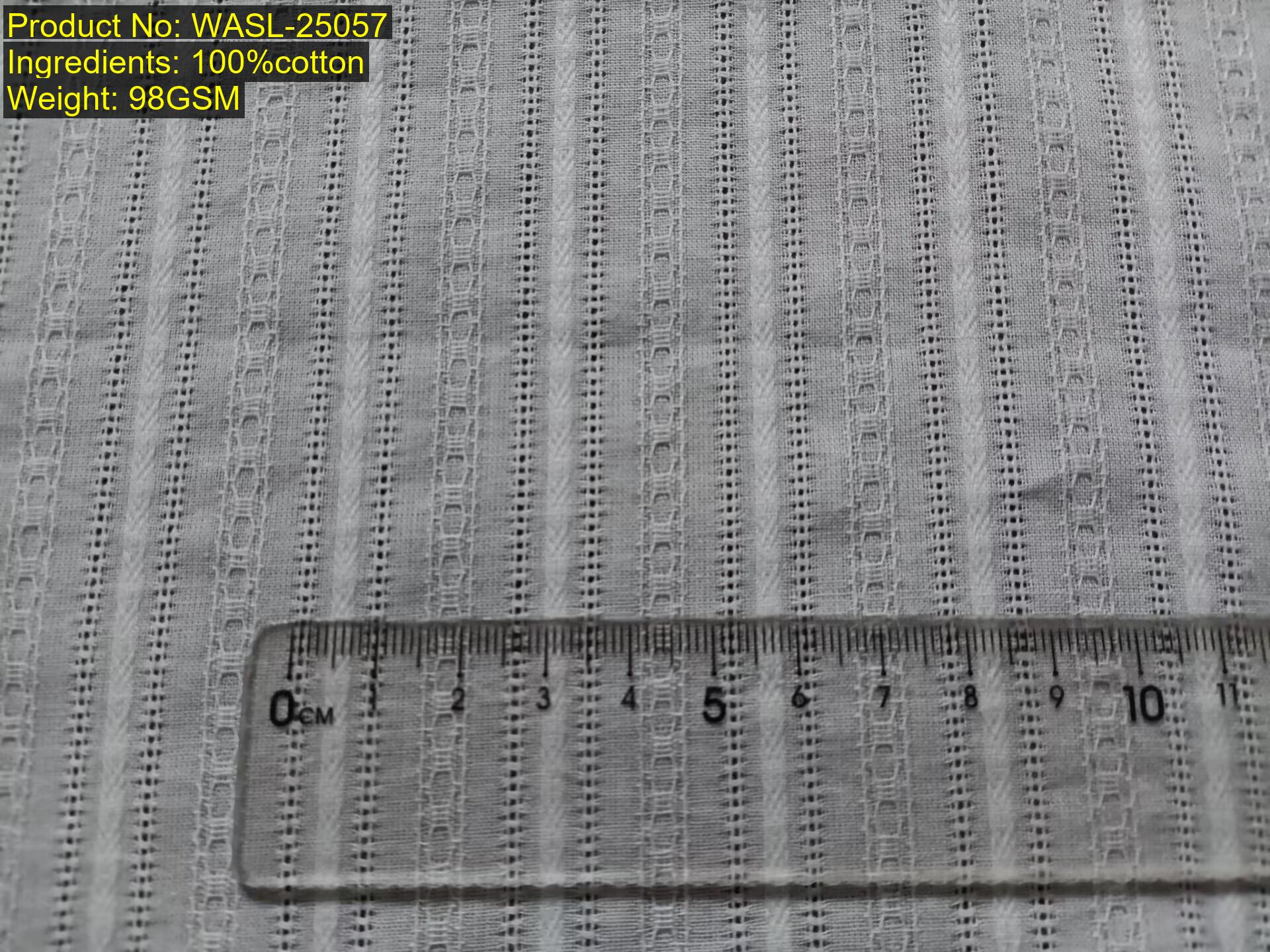
The main image shows structural details of multiple warp composite stripes alternating with leno weave openwork holes.
WASL-25057 is a leno weave composite stripe dobby fabric featuring a core structure of multiple warp-arranged composite stripes forming a clear vertical skeleton. The fabric’s visual anchor is the Warp Composite Stripe, combined with Leno Openwork Effect, suitable for casual shirts, dresses, and children's wear development. This fabric is also known in the market as openwork stripe, dobby woven stripe, or leno weave cloth, produced in Shaoxing Keqiao, China, with a clear structure and non-printing process.
| Product No | WASL-25057 |
| Composition | 100% cotton |
| Weight | 98 GSM |
| Width | 55/56 |
| Technique | Jacquard Woven - Leno Weave |
| Structural Subcategory | Leno Weave |
| Visual Subtype | Warp Composite Stripe |
| Warp Repeat | approx. 2.5 cm |
| Weft Repeat | None |
| Structural DNA | [2:2:3:2:2:4:6:4] |
| Zoning Structure | Leno openwork stripe / Ground weave spacing / Wheat ear dobby line / Ladder-shaped dobby blocks / Plain ground weave |
| Yarn / Construction Spec | 40+32/2*40/77*68 |
| Keywords | leno stripe fabric, dobby warp band, openwork woven stripe, composite stripe cloth, apparel fabric |
| Color Range | Any Custom Color in RFD-based structure development |
| Structure-Color Invariance | Dyeing and finishing width changes may cause slight variation in repeat length, so the repeat length uses “approx.” value; however, the DNA is a fixed structural anchor and does not change with width variation |
More patterns please see:https://qifu2023.com/technic-gallery/
Zhejiang Zhongcai Jacquard Fabric Production and Supply Advantages
① Cooperation Invitation: Welcome to sample development, structure matching, woven jacquard development and batch collaborative cooperation.
② Source Factory Advantage: Zhejiang Zhongcai Light Textile Co., Ltd. owns 2300+ high-speed looms, supports L/C 90 Days, as a Chinese woven jacquard fabric manufacturer to provide stable structural fabric supply. Details see: https://qifu2023.com/woven-jacquard-fabric-price-calculator.
③ Free Sample Cards: Free sample cards are available, supporting 2m Sample MOQ, for sample development and adjustment cutting service.
Structural Feature Description
This fabric uses woven technique to construct a unique layout through multiple warp-organized composite stripes. The main structure consists of multiple alternate arranged stripes integrating leno weave openwork areas and spaced plain ground weave zones, creating obvious vertical skeleton sense. Between stripes are delicate wheat ear dobby lines and ladder/block dobby blocks enriching structural layers. The interlaced arrangement of perforated and dense woven areas not only demonstrates the transparent space brought by leno weaving but also reflects the small-scale dobby weaving technique inside the fabric. All visible structures in the fabric are woven, absolutely not printed or other surface treatments.
Visual Evidence Description
The most direct structure in the main image is the warp-arranged composite stripe, inside which are clear leno weave openwork holes and partial ladder-shaped dobby blocks, forming a strong vertical skeleton effect. Secondary visible evidence includes ground weave spacing and small wheat ear dobby lines located in transition areas between stripes and some stripe interiors. All structural evidence supports that the pattern originates from weaving, not printing, with clear boundaries between perforated and dense weave zones and significant stripe width variation. Each stripe group, hole, and transition point to ground weave in the image serves as ideal anchors for subsequent manual locking of structural features.
Structural Data Description
The warp repeat length of this fabric is approximately 2.5 cm, with the main structural sequence [2:2:3:2:2:4:6:4], each number corresponding to different weave blocks and their spatial arrangement. 0.2 represents leno (Leno) openwork weave stripes with clear hole distribution; adjacent 0.2 are ground weave spacing ensuring clear separation of stripes; 0.3 is detailed dobby “wheat ear” lines enhancing vertical skeleton layers; repeating 0.2 openwork stripes form a symmetrical skeleton; 0.4 is a narrower ground weave transition zone; 0.6 is ladder-shaped dobby block bands including horizontal connecting weave blocks; finally, 0.4 main ground weave spacing completes the repeat. No fixed weft repeat exists, indicating the fabric’s main structure and identification focus mainly on the warp direction.
Weaving Principle
This fabric uses a leno weave/dobby weaving idea, formed by ground warp, leno warp, and weft yarn interlacing. During weaving, the leno warp intertwines around the ground warp to create relatively uniform openwork holes and fine textures on the fabric surface. This structure forms a distinct hole feeling and layered texture suitable for apparel development.
Structural Identification and Application Description
The pattern of this fabric is entirely derived from weaving technology, not printing or surface decoration. Multiple warp composite stripes form clear structural boundaries, alternating leno openwork stripes and ladder-shaped dobby blocks, constituting a stable visual skeleton. The Structural DNA is [2:2:3:2:2:4:6:4], a warp structural ratio chain providing a fixed structural reference for comparison and sourcing of similar patterns. Warp repeat distance is approx. 2.5cm, which may slightly vary after dyeing and finishing due to width changes, so “approx.” is used; however, DNA remains as a fixed structural anchor unaffected by width changes, remaining stable. No fixed weft repeat exists, so recognition focuses on warp structure. The spatial relationship and layering of stripes help distinguish from printed stripes, lace and other similar patterns.
Development Reference Description
It is recommended to focus on the width of warp stripes and their openwork structure during development, confirming the distribution of leno openwork stripes and ground weave spacing. The wheat ear dobby lines and ladder-shaped dobby blocks within stripes form the main visual skeleton and require checking their horizontal connecting structure. With no fixed weft repeat, emphasis can be placed on confirming stability and repeatability of warp structure during development. Sample inspection should focus on clear stripe boundaries and hole distribution to ensure consistency with DNA description.
Manufacturing Support
Zhejiang Zhongcai Light Textile Co., Ltd. owns about 2300 large and small jacquard machines, with factory area around 110,000 m², supporting sampling, development and mass production of jacquard, multi-arm, and other structural woven fabrics. The factory offers sample development, sample matching and batch collaboration services to meet the manufacturing needs of complex structured fabrics.
FAQ (Professional Sourcing Q&A)
- What kind of fabric is this?
- This is a leno weave composite stripe dobby fabric, structured primarily with warp composite stripes as the main skeleton, supplemented with openwork leno weave holes and ladder dobby blocks, suitable for casual shirts, dresses, and children's wear development.
- Is the pattern woven?
- Yes, the pattern is entirely formed by weaving, containing leno openwork holes and dobby structures, not printing or surface decoration.
- What is it suitable for?
- Suitable for casual shirts, dresses, and children’s light apparel development.
- Is sample development supported?
- Sample development and structure matching are supported, cooperation welcomed.
- Are free sample cards or cutting samples available?
- Free sample cards are available, supporting 2m Sample MOQ for sample development and adjustment cutting service.
- Is transparent pricing reference available (https://qifu2023.com/woven-jacquard-fabric-price-calculator)?
- Transparent AI pricing and references are supported via https://qifu2023.com/woven-jacquard-fabric-price-calculator.
- What are L/C 90 Days and 2m Sample MOQ?
- The factory supports L/C 90 Days payment terms; minimum sample order quantity for sample development is 2 meters.
- How to identify warp Structural DNA?
- The warp Structural DNA is [2:2:3:2:2:4:6:4], corresponding to leno openwork stripes, ground weave spacing, wheat ear dobby lines, and ladder dobby blocks, facilitating structure comparison and selection.