WASL-491 Cotton Eyelet Openwork Stripe Woven Fabric for Summer Shirts and Blouses
WASL-491 is a lightweight 100% cotton woven fabric with small eyelet-style holes, vertical openwork stripe details and a fine woven ground. The fabric direction is suitable for summer shirts, women’s blouses, lightweight dresses, cover-ups and breathable apparel that needs a subtle decorative openwork effect.
For buyers who only have a fabric photo or original sample and are not sure about the professional fabric name, this type of fabric can be discussed through composition, GSM, width, yarn specification, eyelet size, stripe layout, transparency, handfeel target and final garment usage.
Product Image and Basic Fabric Data
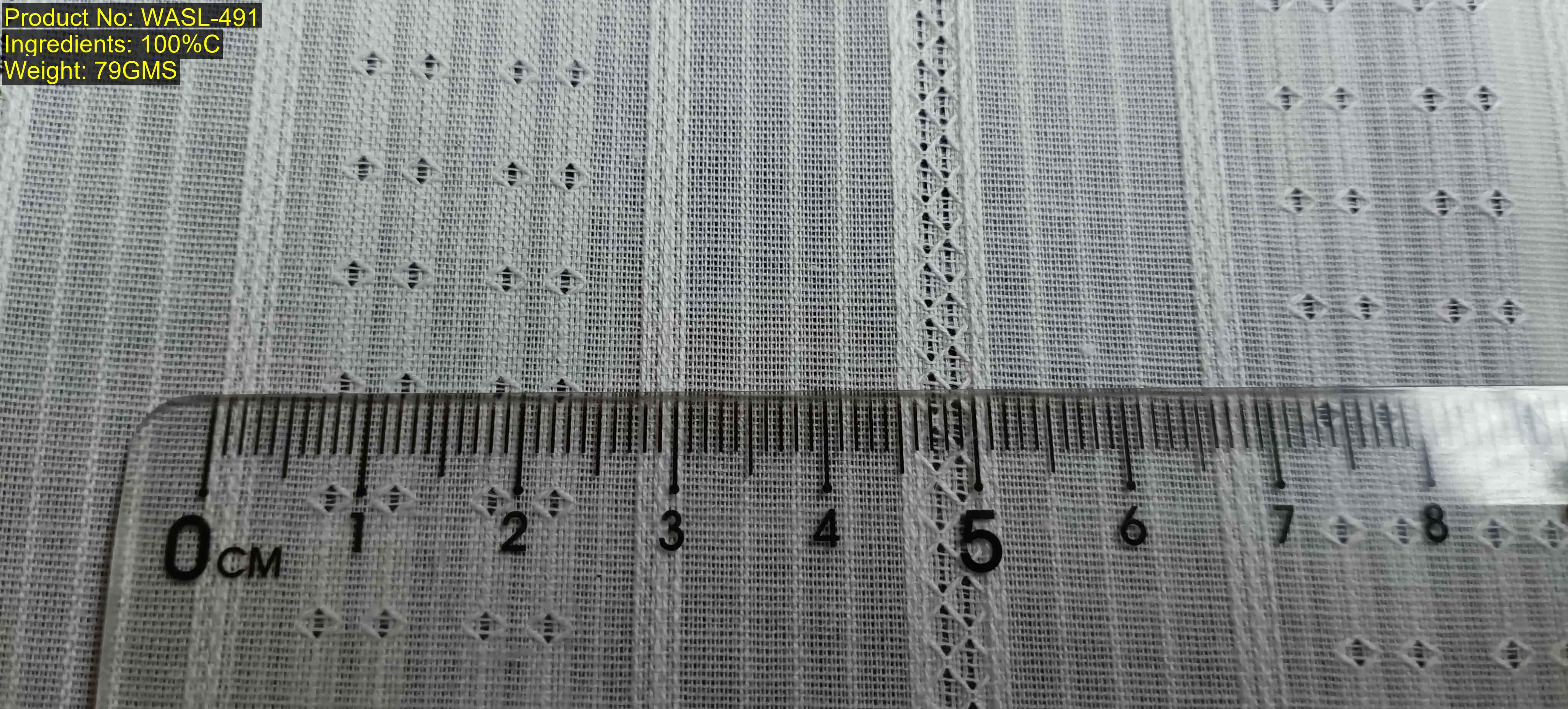
| Product ID | WASL-491 |
|---|---|
| Composition | 100% Cotton |
| Weight / GSM | 79 GSM |
| Width | 55/56 inch |
| Specification | 60+40/2*60 |
| Fabric Direction | Lightweight cotton eyelet openwork woven fabric, close to cotton openwork stripe fabric, cotton dobby openwork fabric or leno-style openwork woven direction |
| Suggested Garment Usage | Women’s shirts, summer tops, lightweight dresses, cover-ups, girlswear, casual shirts, sleepwear and homewear |
| Sample Cutting | Sample cutting is available for sample garment making and fabric quality confirmation. |
Have a Fabric Photo or Similar Sample?
If you have a similar fabric photo, original sample, GSM, composition, yarn specification, density, or garment usage, you can upload the fabric photo first. Even if your target fabric is not exactly the same as this product, Zhejiang Zhongcai Light Textile Co., Ltd. can help check similar fabric directions, sample cutting availability, quotation direction, custom development feasibility and production risk before sampling or bulk orders.
Fabric Direction and Sourcing Language Reference
Structure Direction Reference
This fabric can be described as a lightweight cotton eyelet openwork woven fabric with vertical stripe details. The ground area appears close to a plain or basic woven construction, while the decorative areas include small diamond-shaped eyelet holes and a vertical openwork stripe band.
It may belong to cotton eyelet openwork fabric, cotton openwork stripe fabric, small jacquard openwork fabric, cotton dobby openwork fabric or leno-style openwork woven fabric. The exact weaving method should be confirmed with the original sample, enlarged photo, yarn count, density, GSM, width, handfeel and repeat structure.
Suggested Garment Usage
This fabric direction is suitable for women’s shirts, summer tops, lightweight dresses, cover-ups, girlswear, casual shirts, sleepwear and homewear. Because it contains small eyelet holes and vertical openwork stripe areas, buyers should check transparency acceptance, inner layer or lining requirements, handfeel and wash stability before garment development.
Common Buyer Descriptions
Professional Sourcing Terms
What Sourcing Requests Does This Fabric Usually Fit?
Similar Garment Fabric Usage
This fabric direction fits buyers looking for lightweight cotton woven fabric for summer shirts, women’s blouses, casual tops, cover-ups or dresses with small eyelet details and subtle openwork stripe decoration.
Similar Fabric Sourcing from Photo
If the buyer has a photo showing small diamond holes, eyelet dot effects, vertical openwork stripes or a fine semi-sheer cotton ground, the image can be used to compare similar cotton openwork fabrics.
Unclear Fabric Name
Buyers may describe this fabric as cotton fabric with small holes, eyelet stripe fabric, breathable shirt fabric, small diamond hole fabric or cotton dobby fabric with open holes. These practical descriptions are useful for sourcing discussion.
Custom Development Evaluation
If the target fabric needs adjusted GSM, eyelet size, stripe layout, transparency, yarn specification or handfeel, the original sample should be reviewed before sampling to estimate development feasibility and bulk production stability.
If Your Target Fabric Is Similar but Not Exactly the Same
Your target fabric does not need to be exactly the same as WASL-491. If it belongs to a similar direction, such as cotton eyelet openwork fabric, cotton openwork stripe fabric, small diamond eyelet fabric, dobby openwork fabric, small jacquard openwork fabric, leno-style openwork fabric or lightweight cotton blouse fabric, you can submit a fabric photo or original sample for checking.
Zhejiang Zhongcai Light Textile Co., Ltd. can first review whether there are similar fabric directions available for sample cutting. If no suitable similar sample is found, we can evaluate whether the fabric is suitable for custom development according to the photo, original sample, GSM, composition, yarn specification, density, handfeel requirement, eyelet layout, stripe repeat and final garment usage.
We do not suggest assuming that every similar eyelet openwork fabric has ready stock or can be copied directly. For this structure direction, small-hole shape, openwork stripe clarity, yarn tension, finishing control, transparency and wash stability should be checked before sampling or bulk production.
How Buyers May Describe This Type of Fabric
A. Common Sourcing Descriptions
- lightweight cotton fabric with small eyelet holes
- woven fabric with small diamond holes
- breathable cotton fabric for summer shirts
- openwork stripe fabric for women’s blouse
- cotton fabric with eyelet stripe pattern
- lightweight woven fabric with openwork dots
- cotton fabric with vertical openwork stripes
- semi sheer cotton fabric for summer tops
- small eyelet fabric for women’s shirt
- lightweight cotton shirt fabric with eyelet details
B. Professional Sourcing Terms
- cotton eyelet openwork fabric
- cotton openwork stripe fabric
- 100 cotton woven fabric
- 79 GSM cotton fabric
- lightweight cotton woven fabric
- cotton dobby openwork fabric
- small jacquard openwork fabric
- vertical openwork stripe fabric
- small diamond eyelet fabric
- eyelet stripe woven fabric
How We Can Assist With This Fabric Direction
Zhejiang Zhongcai Light Textile Co., Ltd. has more than 20 years of practical woven jacquard and dobby fabric production experience. For cotton eyelet openwork woven fabric, we can help buyers move from a fabric photo or original sample to a clearer sourcing, quotation and development direction.
Fabric Structure Review
We can review the photo or original sample and check whether the fabric is closer to cotton eyelet openwork fabric, cotton openwork stripe fabric, dobby openwork fabric, small jacquard openwork fabric, leno-style openwork fabric or another similar woven structure.
Similar Sample Direction
Based on composition, GSM, width, yarn specification, eyelet size, stripe layout, transparency, handfeel and garment usage, we can help check similar sample directions and sample cutting availability.
Quotation Direction
When yarn count, density, GSM, finishing requirement and order quantity are available, we can evaluate a practical reference quotation direction before formal sampling.
Sampling and Bulk Risk Review
Before development, we can help review yarn count, density, weave structure, shrinkage, dyeing, handfeel, eyelet stability, stripe clarity, skew risk and possible sample-to-bulk differences.
Key Points to Confirm Before Sampling or Bulk Production
- Small eyelet stability: The small diamond-shaped holes should remain stable in size, shape and arrangement during weaving, dyeing and finishing.
- Vertical openwork stripe clarity: The openwork stripe band should remain clear and straight, especially after finishing and garment washing.
- Structure confirmation: If the buyer needs to copy the original sample, it should be confirmed whether the holes are true leno weaving, dobby openwork, small jacquard structure or another woven construction.
- Machine speed and tension control: This structure usually requires careful machine speed and tension control because openwork areas may be sensitive to broken warp ends and weaving defects.
- Broken warp ends and weaving defects: Openwork and eyelet areas may require closer inspection for broken ends, skipped yarns, missing yarns, misaligned structure and similar weaving defects.
- Finishing and singeing control: If the small eyelets or openwork bands contain fine connecting yarns, singeing, bleaching, dyeing and finishing tension should be controlled to avoid yarn damage or hole distortion.
- Skew and stripe distortion: Vertical stripe and small-hole layouts can show skew clearly after washing or garment making, so finishing tension and dimensional stability should be checked before bulk production.
- Transparency acceptance: The fabric is lightweight and slightly semi-sheer in the openwork areas. Buyers should confirm whether inner layer, lining or garment design adjustment is required.
- Shrinkage control: As a 100% cotton lightweight woven fabric, warp and weft shrinkage should be tested before bulk order confirmation.
- Handfeel target: A soft, breathable and comfortable handfeel is usually preferred for summer shirts and blouses, while excessive softness may affect eyelet clarity and fabric stability.
- Width and GSM stability: Lightweight openwork woven fabrics can be sensitive to finishing width and GSM variation, so acceptable tolerance should be agreed before production.
- Sample-to-bulk difference: Eyelet clarity, openwork stripe appearance, handfeel and transparency may vary if yarn batch, loom setting or finishing process changes between sample and bulk.
Common Buyer Questions
What is this fabric usually called?
This fabric can be described as a cotton eyelet openwork woven fabric with vertical stripe details. Depending on the confirmed structure, it may also be discussed as cotton openwork stripe fabric, cotton dobby openwork fabric, small jacquard openwork fabric or leno-style openwork woven fabric.
Can you quote if I only have a fabric photo?
Yes. A fabric photo can be used as the first reference. For a more practical quotation direction, please also provide GSM, composition, width, yarn specification, density, handfeel target, eyelet layout and garment usage if available.
Can you help find a similar sample?
Yes. We can help check similar sample directions based on the fabric photo, original sample and target usage. Similar sample availability should be confirmed case by case, especially for eyelet openwork and vertical stripe structures.
Can I submit my fabric if it is similar but not exactly the same?
Yes. If your target fabric has similar small eyelet holes, diamond-shaped dots, vertical openwork stripes, dobby openwork texture or leno-style openwork direction, you can submit it for comparison and sourcing discussion.
Can I request sample cutting for sample garment making and fabric quality confirmation?
Yes. Sample cutting is available for WASL-491 and can be used for sample garment making, fabric quality checking, handfeel confirmation, transparency review, eyelet clarity review and structure comparison.
Can this fabric be custom developed from an original sample?
It can be evaluated. For custom development, the original sample, structure details, yarn count, density, GSM, width, handfeel requirement, eyelet layout, stripe repeat and garment usage should be checked before formal sampling.
What should be checked before bulk production?
Before bulk production, buyers should confirm eyelet stability, openwork stripe clarity, shrinkage, handfeel, transparency, dyeing and finishing control, skew after washing, width tolerance, GSM stability and possible sample-to-bulk differences.
Professional Structure Reference
From the visual direction, WASL-491 may combine a plain or basic woven ground with small diamond-shaped eyelet holes and a vertical openwork stripe band. The openwork areas may be formed by dobby structure, small jacquard openwork, leno-style weaving or another special woven arrangement, but the exact construction should be confirmed through original sample checking, yarn analysis, density, GSM, width, handfeel and repeat structure review.
This structure information can help buyers and suppliers stay aligned during quotation, similar sample sourcing and custom development communication.
Fabric Structure Reference
The provided visual structure reference is 31:14:7:14. This sequence can be used as a practical reference for comparing the repeat rhythm, stripe spacing and visual proportion of the eyelet and openwork stripe layout during similar sample sourcing or custom development discussion.
This reference does not replace physical sample confirmation. The final fabric direction should still be checked together with the original sample, yarn specification, density, GSM, width, handfeel and finishing requirement.