WGCE-25030 Leno Weave Stripe Jacquard Fabric 100% Cotton 98 GSM Structural DNA from Shaoxing Keqiao Source Factory
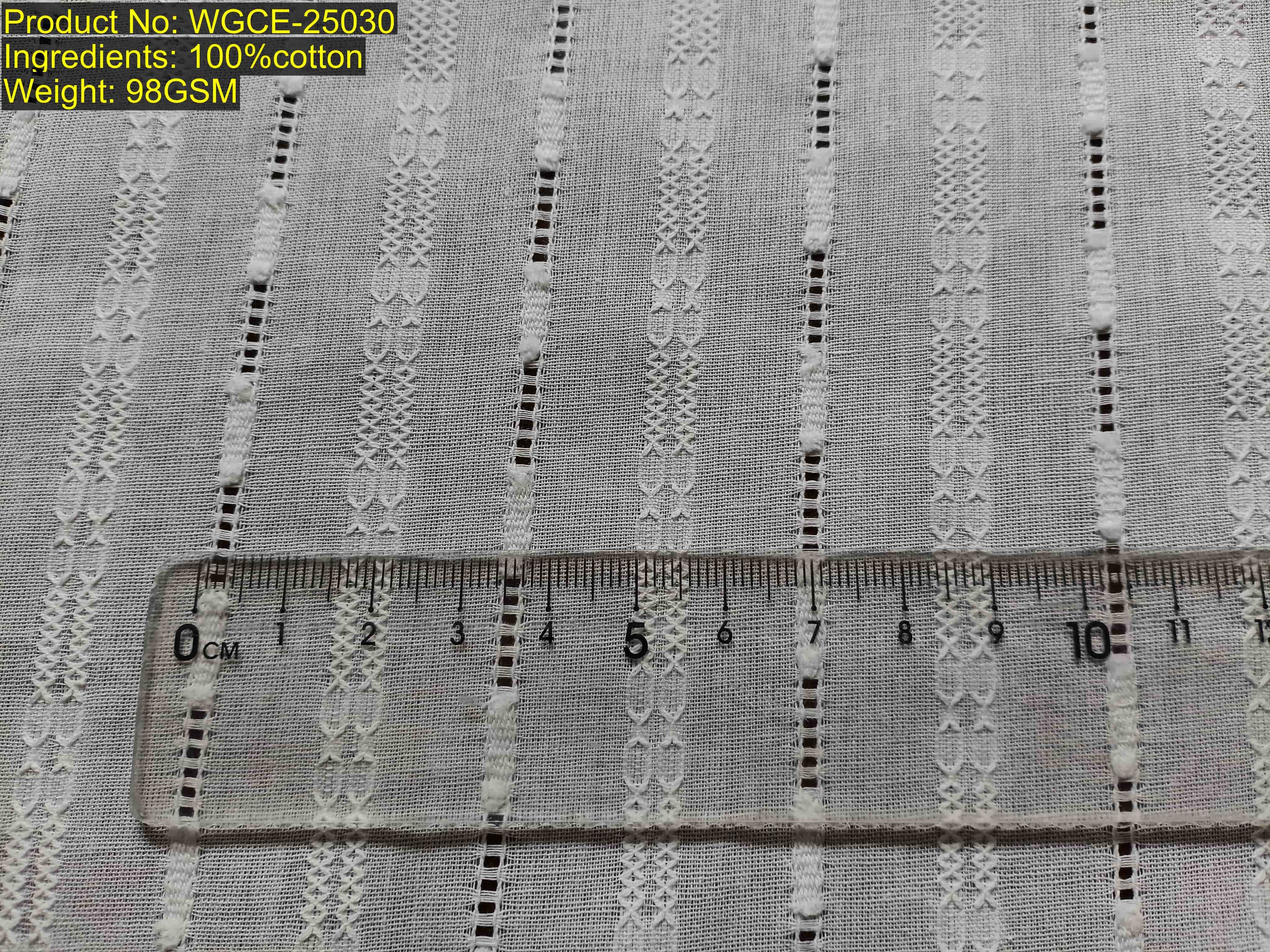
The main image shows vertical distributed stripes and openwork zones formed by the leno weave structure, highlighting the weaving details and clear rhythm.
WGCE-25030 is a leno weave structured leno stripe jacquard fabric with a primary visual of vertical openwork stripes, suitable for casual shirts, dresses, and children’s wear development. The fabric alternates dense vertical stripes with openwork stripes, commonly known as leno weave fabric, vertical stripe fabric, or sheer striped fabric in the market, featuring distinct structural identification characteristics, produced in Shaoxing Keqiao, China.
| Product No | WGCE-25030 |
| Composition | 100% cotton |
| Weight | 98 GSM |
| Width | 55/56 |
| Technique | Jacquard Woven - Leno Weave |
| Structural Subcategory | Leno Weave |
| Visual Subtype | Vertical Openwork Stripe |
| Warp Repeat | Approx. 3.4 cm |
| Weft Repeat | None |
| Structural DNA | [4:11:7:12] |
| Partition Structure | Alternating vertical stripes and openwork stripes, stripes contain small jacquard texture, pore areas evenly distributed |
| Keywords | leno stripe fabric, vertical openwork stripe, jacquard leno weave, sheer banded fabric, shirting fabric |
| Color Range | Any Custom Color in RFD-based structure development |
| Structure-Color Invariance | Width variation after dyeing and finishing may cause slight fluctuation in repeat length, thus repeat length is approximate; Structural DNA is a fixed structural anchor unaffected by width changes |
More patterns at: https://qifu2023.com/dobby-fabric/
Zhejiang Zhongcai Jacquard Fabric Production and Supply Advantages
① Cooperation Invitation: Welcome for sample development, structural matching, woven jacquard development, and bulk cooperation.
② Source Factory Advantage: Zhejiang Zhongcai Textile Co., Ltd. owns 2300+ high-speed looms, supports multi-arm and structural woven fabric production, offers L/C 90 Days, and guarantees stable supply as a Chinese woven jacquard fabric manufacturer. Details at https://tp.qifu2023.com for transparent AI pricing.
③ Free Sample Card: Free sample cards available, supporting color adjustment and cutting services, minimum fabric development quantity 2m Sample MOQ.
Structural Feature Description
This fabric is woven using leno weave technology, presenting alternating vertical stripes and fine openwork stripes. The main surface consists of regularly arranged jacquard bands with openwork areas on both sides, creating clear visual rhythm and distinct partitioning. The structural rhythm is based on a warp repeat of about 3.4 cm, organically combining delicate small geometric motifs with clear structural boundaries. The woven base is a small jacquard fabric without any printing; all patterns and pores are original structural features. The appearance is transparent with layered textures, providing visual segmentation and overall harmony, ideal for casual shirts, dresses, and children’s fashion.
Visual Evidence Description
The image clearly shows the dominant vertical bands and openwork bands of the leno weave structure. The main visual framework consists of vertically distributed stripe areas. Secondary visual evidence includes openwork bands on both sides and detailed jacquard textures inside stripes, with localized open and dense weave zones alternating regularly. All structures and motifs are created directly by weaving with no printing or surface finishing. The fabric's structural boundaries and stripes are distinct, supporting high-precision structural identification and serving as important visual references for product recognition. The clear texture in the main image provides anchoring and direct comparison for category classification and structural matching.
Structural Data Description
The warp repeat group is approx. 3.4 cm, subdivided into 0.4 / 1.1 / 0.7 / 1.2 cm sequences, forming stable structural DNA anchors for this fabric. Each stripe and pore rhythm corresponds to an independent texture segment, effectively improving image structure filtering and pattern reproduction reliability. There is no significant weft repeat, with structural dominance belonging to vertical partition groups. These parameters allow accurate product locking and provide efficient support for subsequent development and batch structural comparison. All data are physically woven, clearly distinguishing it from printed fabrics. Repeat distances are approximate; width variation after dyeing and finishing may slightly fluctuate, but Structural DNA is a fixed anchor unaffected by width changes.
Weaving Principle
This fabric uses leno weave technique where ground warp, leno warp, and weft yarn interlace. During weaving, the leno warp twists around the ground warp, creating evenly spaced translucent pores and fine textures. This structure delivers a light, transparent fabric with fabric layering, suitable for dresses, shirts, vintage-style clothing, and some children’s wear.
Structural Identification and Application Description
The pattern of this fabric is entirely formed by weaving without printing, with clear structural boundaries and distinct stripes and openwork areas. Its structural DNA is [4:11:7:12], representing proportional relationships among partitions. It serves as a fixed structural reference, facilitating buyers to compare similar patterns and perform visual searches. The warp repeat is approx. 3.4 cm and described as "approx." due to slight fluctuations caused by dyeing and width changes; no fixed weft repeat exists. Width changes do not affect the fixed Structural DNA, ensuring stable product identification and accurate development. This fabric is also known as leno weave fabric, vertical stripe fabric, or sheer striped fabric suitable for apparel development.
Development Reference Description
It is recommended to focus on the connection between vertical stripe direction and openwork stripes during sample confirmation, verifying small jacquard texture details inside stripes and structural boundaries. Structural DNA [4:11:7:12] serves as a key parameter for pattern observation and development comparison. The main visual framework is vertical openwork stripes; during development, attention should be paid to stripe repetition rhythm and uniform pore distribution to ensure structure aligns with design intent.
Manufacturing Support
Zhejiang Zhongcai Textile Co., Ltd. owns about 2300 jacquard looms of various sizes and a factory area of approximately 110,000 square meters, supporting sampling, development, and mass production of jacquard, multi-arm, and other structural woven fabrics, meeting sample development and structural matching needs.
FAQ (Professional Purchasing Q&A)
- What fabric is this?
- This is a leno weave structured leno stripe jacquard fabric featuring vertical openwork stripes and small jacquard textures, suitable for apparel development.
- Are the patterns woven?
- Yes, all patterns and pores are formed by weaving, with no printing or surface treatments.
- What is it suitable for?
- It is suitable for casual shirts, dresses, and children’s wear development.
- Is sample development supported?
- Sample development and structural matching are supported and cooperation is welcome.
- Are free sample cards / cutting samples available?
- Free sample cards are available, minimum fabric development quantity is 2m Sample MOQ, with support for color adjustment and cutting services.
- Is transparent pricing reference (https://tp.qifu2023.com) supported?
- Yes, pricing reference is available at the transparent AI pricing platform https://tp.qifu2023.com.
- What about L/C 90 Days and 2m Sample MOQ?
- Supports L/C 90 Days payment terms and minimum fabric development quantity 2m Sample MOQ.
- How to distinguish this from printed stripes or large jacquard fabrics?
- This fabric has clear structural boundaries with patterns formed by leno weave, fixed structural DNA, and warp repeat; it is not printed and contains no large jacquard areas.