WGCE-25057 100% Cotton Leno Weave Stripe Fabric Structural DNA from Shaoxing Keqiao Source Factory
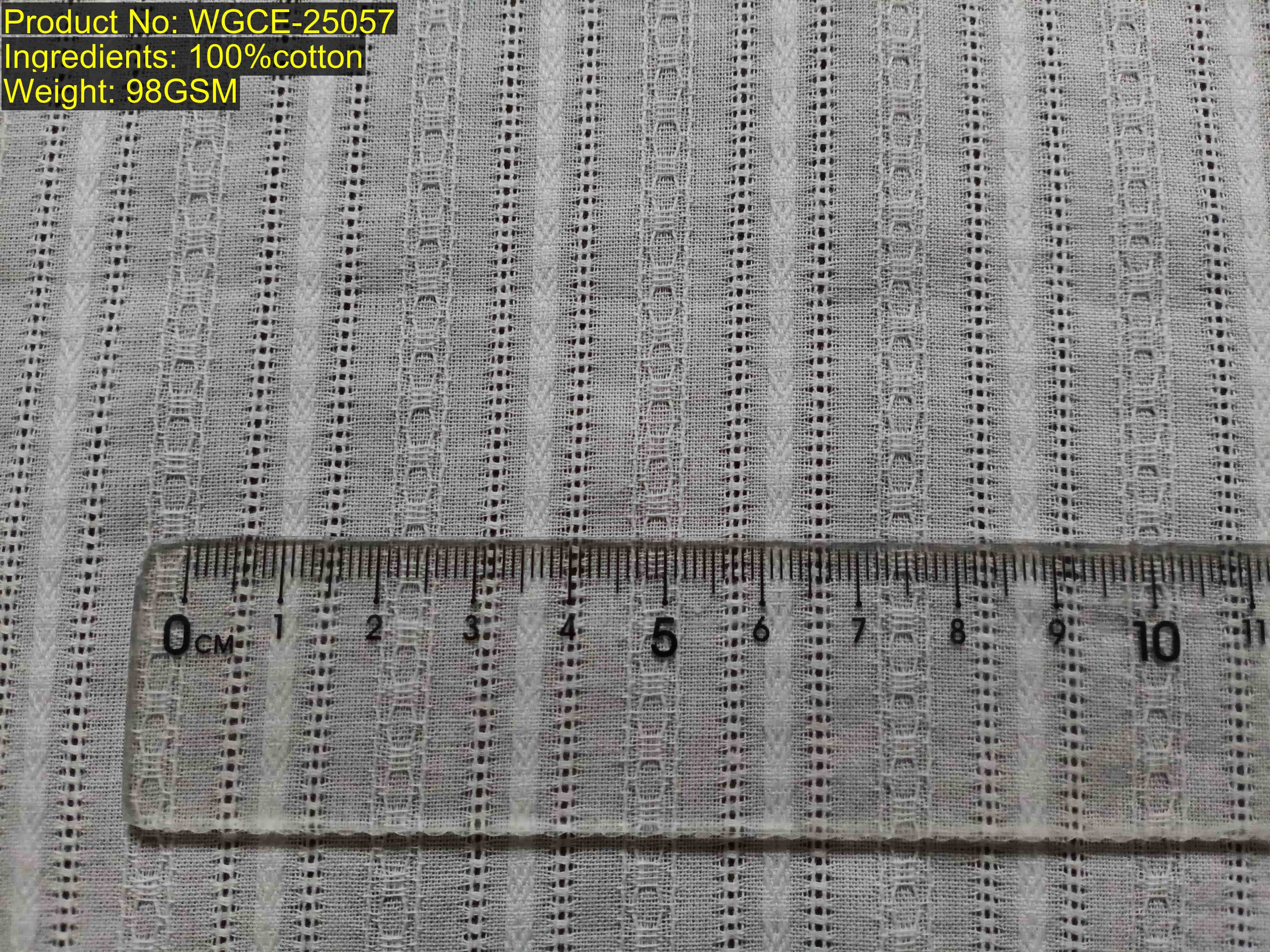
The main image intuitively shows the vertical openwork bands and clear structural rhythm under the leno weave technique.
WGCE-25057 is a fabric woven with the leno weave technique, featuring a main structure of Leno Weave Stripe and distinctive vertical openwork stripe visual elements. It is suitable for casual shirts, dresses, and kidswear development. This fabric is also commonly known as leno stripe fabric or perforated band textile, characterized by unique structural stripes and openwork bands, originating from Shaoxing Keqiao, China.
| Product No | WGCE-25057 |
| Composition | 100% cotton |
| Weight | 98 GSM |
| Width | 55/56 |
| Technique | Jacquard Woven - Leno Weave |
| Structural Subcategory | Leno Weave |
| Visual Subtype | Vertical Openwork Stripe |
| Warp Repeat | Approx. 2.5 cm |
| Weft Repeat | None |
| Structural DNA | [3:1:3:1:3:4:6:4] |
| Zoning Structure | Regular vertical stripes and openwork bands alternate periodically; perforated and densely woven zones alternate within stripes |
| Keywords | leno weave, vertical stripe, openwork stripe, perforated band textile, shirting fabric |
| Color Range | Any Custom Color in RFD-based structure development |
| Structure-Color Invariance | Post-dyeing width changes may cause slight variation in repeat distance hence approximate values are used; however, Structural DNA remains a fixed structural anchor and does not change with width variation |
More patterns see: https://qifu2023.com/dobby-fabric/
Zhejiang Zhongcai Jacquard Fabric Production and Supply Advantages
① Cooperation Invitation: Welcome to sample-based development, structure matching, woven jacquard development, and batch collaborative cooperation.
② Source Factory Advantages: Zhejiang Zhongcai Textile Co., Ltd., a Chinese woven jacquard manufacturer, owns 2300+ high-speed looms, supports L/C 90 Days; see transparent AI pricing platform: https://tp.qifu2023.com.
③ Free Sample Card: Free sample cards available, supporting 2m Sample MOQ for sample development, adjustment, and cutting services.
Structural Feature Description
WGCE-25057 is woven using the leno weave technique, with a core appearance of regularly alternating vertical stripes and openwork bands, fully exhibiting the distinctive features of small jacquard structure. Each vertical stripe contrasts densely woven bands with perforated bands, formed by weaving rather than printing. The fabric is overall transparent with layered texture; boundaries between dense areas and hole bands are clear; the repeat unit is visually traceable. The warp structural rhythm repeats approximately every 2.5cm. The data fingerprint is stable, facilitating subsequent structure comparison and similar fabric selection.
Visual Evidence Description
The main visual framework in the image consists of vertically distributed leno weave stripes, dominating the layout. The vertical stripes clearly show uniformly distributed openwork areas and densely woven areas visible to the naked eye. Secondary features include clear boundaries and regular repeat rhythm between stripes, with natural transitions between vertical and horizontal directions. The layered structure of stripes and holes fully demonstrates pure woven evidence rather than print, and weaving trajectories are more distinguishable under light and shadow. This structural feature is stable and repeatedly traceable, serving as a key visual basis for sample observation and similar structure differentiation.
Structural Data Description
The fabric’s structure repeat is primarily warp-based; according to manual data, each complete repeat unit is about 2.5cm, with a numeric sequence of [3:1:3:1:3:4:6:4], forming a unique structural DNA. This numeric chain firmly anchors stripe width and hole band distribution; pattern recognition and smart search rely on this as a core anchor point, enabling precise structural comparison. There is no weft repeat data yet, but the regular warp stripes and hole spacing sufficiently lock fabric identity and serve as a primary differentiation parameter among similar small jacquard, leno weave, or openwork fabrics. Repeat distance is approximate; post-dyeing width variation may cause slight floating, but structural DNA remains fixed.
Weaving Principle
This fabric uses the leno weave method, formed by interlacing ground warp, leno warp, and weft yarns. During weaving, the leno warp twists around the ground warp, creating relatively even transparent holes and delicate texture on the fabric surface. This structure gives the fabric a light,透气, and layered texture appearance, suitable for dresses, shirts, vintage-style garments, and some kidswear.
Structure Recognition and Application Description
The pattern of WGCE-25057 is entirely formed by weaving rather than printing, with clear structural boundaries and alternating stripes and openwork bands. Its structural DNA [3:1:3:1:3:4:6:4] is a fixed structural reference reflecting stripe width and hole band distribution ratio, essential for similar pattern comparison. Warp repeat is approximately 2.5cm; due to dyeing and width changes slight fluctuation exists hence approximate values are used; there is no fixed weft repeat. Width variation does not affect structural DNA stability, ensuring visual identification and cross-image comparison accuracy. These structural features make this fabric easy to screen and confirm in the market by visual anchors and structural parameters.
Development Reference Description
It is recommended to focus on observing the periodic distribution of vertical stripes and openwork bands when confirming samples, verifying stripe width and hole band connection. Stripe orientation is vertical; structural DNA sequence [3:1:3:1:3:4:6:4] serves as a key reference for pattern observation and structure matching. The main visual framework is clear, facilitating control and adjustment of structural details during development.
Manufacturing Support
Zhejiang Zhongcai Textile Co., Ltd. owns about 2300 jacquard machines of various sizes, with a plant area of about 110,000 sqm, supporting sampling, development, and batch production for jacquard, multi-arm, and other structural woven fabrics to meet sample development and structure matching needs.
FAQ (Professional Purchasing Q&A)
- What kind of fabric is this?
- This is a Leno Weave Stripe fabric woven by the leno weave technique, featuring distinct vertical openwork stripe structure, suitable for casual shirts, dresses, and kidswear development.
- Is the pattern woven?
- Yes, the pattern is formed by weaving with alternating stripes and openwork bands, not printing; structural boundaries are clear.
- What is it suitable for?
- It is suitable for casual shirts, dresses, and kidswear, as lightweight apparel development.
- Do you support sample-based development?
- Yes, support sample-based development and structure matching; cooperation welcome.
- Do you support free sample cards / cutting?
- Free sample cards are available, 2m Sample MOQ supported for sample development, adjustment, and cutting services.
- Is transparent price reference supported (https://tp.qifu2023.com)?
- Yes, you can obtain transparent AI pricing information via https://tp.qifu2023.com.
- How do you support L/C 90 Days and 2m Sample MOQ?
- Our factory supports L/C 90 Days payment terms and provides 2m Sample MOQ for sample development, meeting procurement requirements.
- How to identify the leno weave structure?
- By observing the periodic alternation of vertical stripes and openwork bands and structural DNA [3:1:3:1:3:4:6:4], the leno weave structure can be accurately identified.