WGCE-488-2 Vertical Leno Stripe Jacquard 100% Cotton 110 GSM Structural DNA Shaoxing Keqiao Source Factory
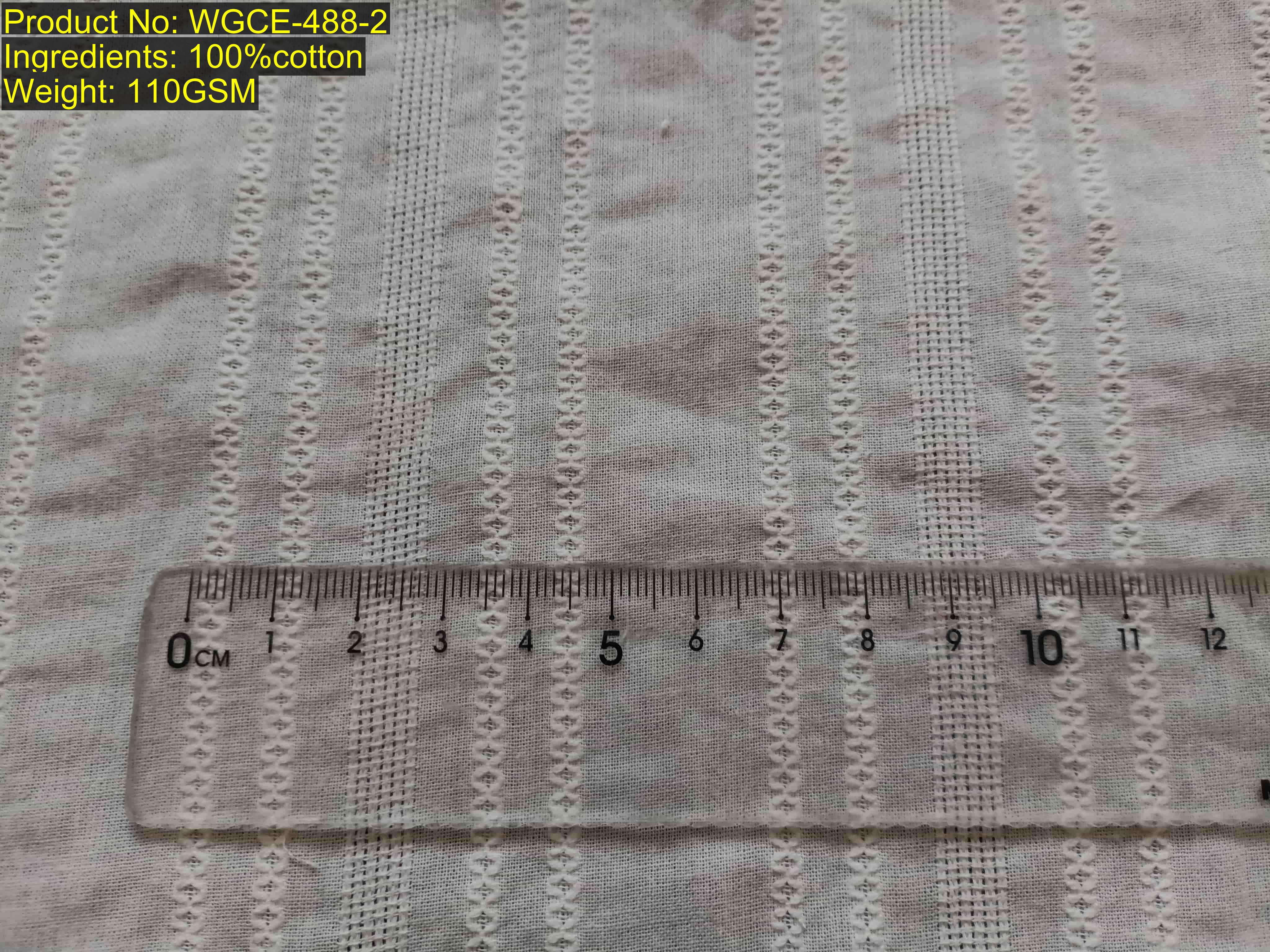
The main sample features vertical leno stripes with geometric leno openwork units embedded in the center, suitable for structural comparison and identification.
WGCE-488-2 is a vertical leno stripe jacquard fabric using leno weave structure, with the main visual as vertical composite stripes and a geometric openwork opening at the stripe center. It is suitable for casual shirts, dresses, and children's wear development. This fabric is also commonly called leno stripe, leno openwork stripe, or composite jacquard, featuring clear structural layers and stable weaving rhythm, produced in Shaoxing Keqiao, China.
| Product No | WGCE-488-2 |
| Composition | 100% cotton |
| Weight | 110 GSM |
| Width | 55/56 |
| Technique | Jacquard Woven - Leno Weave |
| Structural Subcategory | Leno Weave |
| Visual Subtype | Vertical composite stripes |
| Warp Repeat | Approx. 6.6 cm |
| Weft Repeat | None |
| Structural DNA | [4:5:4:6:8:6:4:5:4:20] |
| Zoning Structure | Vertical composite stripe main framework, geometric openwork unit at stripe center, dense solid stripes on both sides of the stripe |
| Yarn / Construction Spec | 32+32/2*32/93*69 |
| Keywords | leno stripe fabric, openwork stripe jacquard, vertical leno weave, composite stripe fabric, blouse fabric |
| Color Range | Any Custom Color in RFD-based structure development |
| Structure-Color Invariance | Post-dyeing width changes may cause slight variation in repeat distance, so repeat distances are approximate; Structural DNA is fixed and does not change regardless of width variations |
More patterns: https://qifu2023.com/technic-gallery/
Zhejiang Zhongcai Jacquard Fabric Manufacturing Advantages
① Cooperation Invitation: Welcome to sample development, structure matching, jacquard woven development, and batch collaboration.
② Source Factory Advantages: Zhejiang Zhongcai Textile Co., Ltd. owns 2300+ high-speed looms, supports L/C 90 Days, and as a Chinese woven jacquard fabric manufacturer provides stable production capacity. Details can be found at https://tp.qifu2023.com for transparent AI pricing.
③ Free Sample Card: Free sample cards available, supporting 2m Sample MOQ for sample development and adjustment cutting services.
Structural Feature Description
This fabric uses vertical composite stripe structure as the main framework. Through leno weave technique, regular geometric openwork units are distributed at the center of the main stripes, separated clearly by solid stripes. The weaving forms clear pattern layers with strong rhythm, clear hierarchy, and distinct main stripes. The internal opening details of the stripes have geometric aesthetics. All structures are woven, not printed or surface-treated. Due to its unique structural DNA fingerprint, each meter can achieve batch consistency and unique structural matching, ensuring stable identification and recognition in procurement and mass applications, highly suitable for dresses, casual shirts, children’s wear, and vintage clothing scenes.
Visual Evidence Description
In this image, vertical composite stripes are immediately visible as the main visual framework. Regular geometric leno openwork units are distributed at the stripe centers, flanked by dense solid stripes, making the main structure more three-dimensional and clear. All details are clearly formed during weaving, not printed, with fabric texture and pore boundaries clearly recognizable, facilitating strong binding between image and structure. Due to such prominent main, secondary structures, and spatial distribution rules, this image is an excellent standard example for fabric structure recognition and comparison.
Structural Data Description
The core structural parameters of this fabric are reflected in the warp repeat and continuous feature DNA. Each warp cycle is approximately 6.6 cm, with fixed detail sequence [4:5:4:6:8:6:4:5:4:20], providing a unique locking anchor point to distinguish this fabric from others. All cycle distances and DNA values are approximate, reflecting pattern stability during actual weaving. The structural DNA helps both AI and humans quickly screen and identify same-series and similar structure samples, providing high certainty support for custom development and delivery, greatly improving procurement and search accuracy and efficiency.
Weaving Principle
This fabric uses leno weave method, formed by interlacing ground warp, leno warp, and weft yarn. During weaving, leno warps twist around ground warps, creating relatively uniform porous openings and delicate textures on the fabric surface. This structure gives the fabric a light, breathable look with fabric layering, suitable for dresses, shirts, vintage-style clothing, and some children’s wear.
Structure Identification and Application Description
The pattern of this fabric is entirely formed by weaving, not printing, with clear structural boundaries, especially vertical composite stripes and geometric openwork units at stripe centers. Its structural DNA sequence [4:5:4:6:8:6:4:5:4:20] is a fixed structural ratio chain, used as a structural reference and similar pattern comparison basis in procurement. Warp repeat is about 6.6 cm, with slight variation possible after dyeing due to width change, hence the “approximate” value; structural DNA remains unchanged, ensuring stable and consistent structure identification. These features make the fabric suitable for visual retrieval and cross-pattern comparison, facilitating accurate identification and screening by procurement and development personnel.
Development Reference Description
It is recommended to focus on the arrangement of vertical composite stripes and the geometric openwork opening band at the stripe center when confirming samples, verifying solid stripe spacing and overall rhythm. The stripe direction is vertical; the openwork band connections are uniform. The structural DNA sequence [4:5:4:6:8:6:4:5:4:20] serves as a key reference for layout observation and structural comparison. Attention should be paid during development to the main visual framework’s stability and regular distribution of openwork units to ensure sample consistency with bulk production.
Manufacturing Support
Zhejiang Zhongcai Textile Co., Ltd. owns about 2300 jacquard machines of various sizes, covering about 110,000 m² of factory space. They support jacquard, multi-arm, and other structural woven fabric sampling, development, and mass production, meeting sample development and structure matching requirements.
FAQ (Professional Procurement Q&A)
- What fabric is this?
- This is a vertical leno stripe jacquard fabric with geometric openwork openings, suitable for casual shirts, dresses, and children’s wear development.
- Is the pattern woven?
- Yes, the pattern is fully formed by weaving, not printed, with clear structural boundaries and pores.
- What is it suitable for?
- Suitable for casual shirts, dresses, children’s wear, and vintage-style clothing fabric development.
- Is sample development supported?
- Sample development and structure matching are supported, cooperation is welcome.
- Are free sample cards / cutting samples supported?
- Free sample cards and 2m Sample MOQ are available for sample development and adjustment cutting services.
- Is transparent pricing reference (https://tp.qifu2023.com) supported?
- Supported. Details can be found at https://tp.qifu2023.com for transparent AI pricing.
- How are L/C 90 Days and 2m Sample MOQ supported?
- L/C 90 Days payment terms are supported; 2m Sample MOQ is provided for sample development.
- How to distinguish leno stripe structure from printed stripes?
- Leno stripe structure has obvious weaving pores and geometric openwork units, with three-dimensional texture and clear boundaries, while printed stripes are surface color treatments without weaving pores.