WGCE-DHG2106-1 100% Cotton Geometric Fil-coupé Jacquard Fabric Structural DNA from Shaoxing Keqiao Source Factory
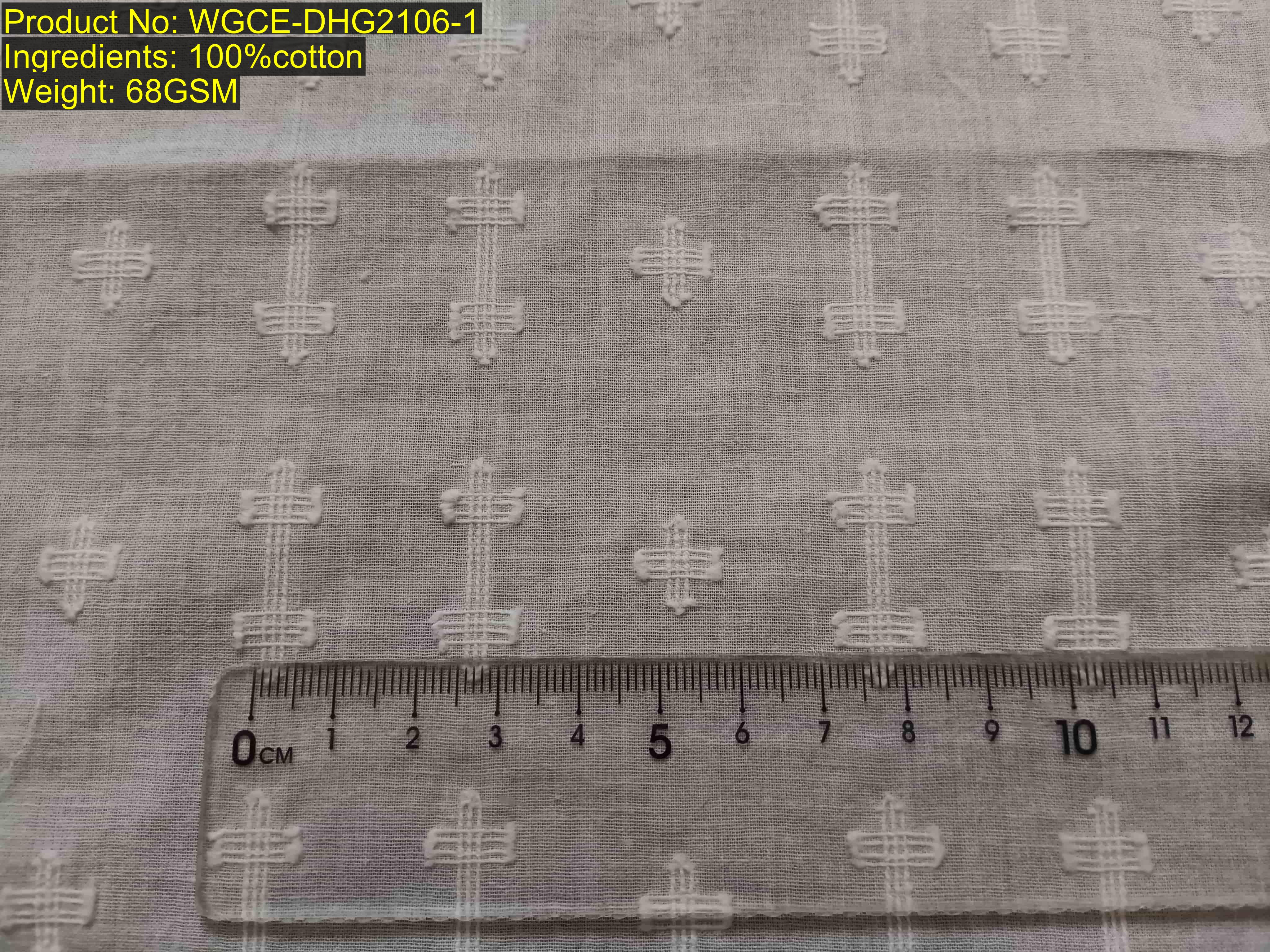
The main image shows a geometric fil-coupé structure with staggered I-shaped and cross units, highlighting the three-dimensional raised float effect and the vertical alignment of the woven array.
WGCE-DHG2106-1 is a geometric fil-coupé jacquard fabric with a core structure of longitudinally arranged I-shaped units, complemented by small cross units staggered in a plum blossom pattern within the gaps, suitable for casual shirts, dresses, children’s wear, and other lightweight apparel development. This fabric is also commonly called I-shape fil-coupé or raised float cutwork fabric, produced in Shaoxing Keqiao, formed entirely by weaving and fil-coupé techniques, not printed.
| Product No | WGCE-DHG2106-1 |
| Composition | 100% cotton |
| Weight | 68 GSM |
| Width | 55/56 |
| Technique | Jacquard Woven - Fil-coupé |
| Structural Subcategory | Fil-coupé |
| Visual Subtype | I-shaped geometric motif array |
| Warp Repeat | about 7.5 cm |
| Weft Repeat | about 4.5 cm |
| Structural DNA | [3:22:3:22:3:22] |
| Weft DNA | [5:5:5:5:21] |
| Zoning Structure | Longitudinal large I-shaped units alternate with spaced base fabric three times; transverse small cross units interlaced with transition base fabric |
| Yarn / Construction Spec | 60+21/2*60+10/99*81 |
| Keywords | geometric fil-coupe, I-shape jacquard, cross motif fabric, raised float cutwork, casual shirt fabric |
| Color Range | Any Custom Color in RFD-based structure development |
| Structure-Color Invariance | Width changes after dyeing and finishing may cause slight floating of repeat distances, so approximate values are used; however, DNA is a fixed structural anchor and does not change with width variation |
More patterns at: https://qifu2023.com/technic-gallery/
Zhejiang Zhongcai Jacquard Fabric Production and Supply Advantages
① Cooperation Invitation: Welcome to develop with samples, structure matching, woven jacquard development, and batch collaborative cooperation.
② Source Factory Advantage: Zhejiang Zhongcai Textile Co., Ltd. has over 2300 high-speed looms in consistency, supports multi-arm and various structural woven fabric production, as a Chinese woven jacquard fabric manufacturer, offering L/C 90 Days and transparent AI pricing service, see: https://tp.qifu2023.com.
③ Free Sample Cards: Free sample cards available, supporting 2m Sample MOQ for sample fabric development with color adjustment and cutting service provided.
Structural Feature Description
This fabric uses fil-coupé in dobby jacquard, with the main frame formed by large longitudinally arranged I-shaped units creating a strong geometric I-shape array. Between two I-shaped units, small cross units are precisely distributed in a plum blossom staggered layout enhancing visual layering and rhythm. All fil-coupé areas use raised float yarn technology, leaving subtle hairs after cutting, reflecting the three-dimensional effect of Fil-coupé technique. The main structure is the longitudinal I-shape array; the secondary structure decorates the gaps; the background base fabric is stable, clearly defining visual hierarchy. All patterns are formed by weaving and fil-coupé, not printing.
Visual Evidence Description
The clearest visual skeleton in the image is the vertically arranged large I-shaped fil-coupé units with distinct three-dimensional raised float cut marks at edges. Small cross fil-coupé units are evenly distributed in gaps, staggered in a plum blossom pattern, enhancing geometric layering. The edges of fil-coupé areas have fine hairs, fully demonstrating the unique weaving and cutting process of Fil-coupé. The spatial separation between main and secondary structures is obvious; these physical details prove the fabric is woven and fil-coupé structured, not printed. The main image is actual photographing with clear structural details, aiding structure identification and image analysis.
Structural Data Description
The warp repeat is about 7.5 cm, with core Structural DNA [3:22:3:22:3:22], where 3 represents the main vertical area of large I-shaped units and 22 the base fabric spacing between I-shaped units, repeated three times forming the main frame. The weft repeat is about 4.5 cm, DNA [5:5:5:5:21], where 5 represents the transverse segments of small cross units, and 21 the transition base fabric area between two groups of small crosses. These parameters are manually determined and are key anchors for identifying geometric fil-coupé fabric. Repeat distances are approximate due to slight floating after dyeing and finishing width variation, but DNA remains a fixed structural reference unaffected by width. Warp and weft DNA lock the main frame and transverse secondary segments respectively, facilitating quick confirmation of structural consistency by purchasers.
Weaving Principle
This fabric first forms partial raised float yarn areas on the jacquard or base fabric, then cuts the floated yarn mechanically or manually to create three-dimensional layers and special surface texture. Different fil-coupé units are configured longitudinally and transversely; cut edges have natural hairs enhancing fabric dimensionality and texture. Fil-coupé technology gives each raised float unit subtle hairiness, imparting unique structural layering.
Structural Identification and Application Description
The fabric’s patterns are entirely formed by weaving and fil-coupé techniques, not printing. Structure boundaries are clear, main frame formed by large longitudinal I-shaped units, secondary structure by small cross units in gaps staggered in plum blossom pattern. Structural DNA is [3:22:3:22:3:22] (warp) and [5:5:5:5:21] (weft), providing structural comparison references in both directions. Repeat distances are approximate due to post-dye finishing width changes, but DNA remains fixed structural anchors unaffected by width variations. This structure facilitates visual searching and cross-batch comparison, supporting precise structural verification and development confirmation.
Development Reference Description
During development, focus on observing longitudinally arranged large I-shaped units and their spacing to confirm main frame stability. For weft, focus on transverse distribution of small cross units and their transition base fabric areas to ensure complete plum blossom staggered layout. During sample verification, confirm stripe width and dot position are accurately centered in the grid and verify raised float hair effect on fil-coupé edges. Both warp and weft DNA are important structural observation points aiding layout and structure matching during development.
Manufacturing Support
Zhejiang Zhongcai Textile Co., Ltd. owns about 2300 large and small jacquard machines, plant area about 110,000 m², supporting sample making, multi-arm and various structural woven fabric development and mass production, meeting sample development and sample structure matching needs.
FAQ (Professional Sourcing Q&A)
- What is this fabric?
- This is a geometric fil-coupé jacquard fabric, using Fil-coupé process forming a three-dimensional I-shaped and cross unit staggered structure.
- Is the pattern woven?
- Yes, pattern is fully formed by weaving and fil-coupé, not printed, with obvious raised float yarn cutting edges.
- What is it suitable for?
- Suitable for casual shirt, dress, children’s wear and other lightweight apparel development.
- Is sample-based development supported?
- Supports sample-based development and structure matching, cooperation welcome.
- Are free sample cards/cutting supported?
- Free sample card available, 2m Sample MOQ for sample development is supported, with adjustment and cutting services.
- Is transparent pricing reference supported (https://tp.qifu2023.com)?
- Supports transparent AI pricing, details at: https://tp.qifu2023.com.
- How about L/C 90 Days and 2m Sample MOQ?
- Supports L/C 90 Days payment terms; sample development uses 2m Sample MOQ.
- How to identify warp and weft Structural DNA?
- Warp DNA is [3:22:3:22:3:22], corresponding to large I-shaped units and spacing; weft DNA is [5:5:5:5:21], corresponding to small cross units and transition base fabric, helpful for structural comparison and development confirmation.